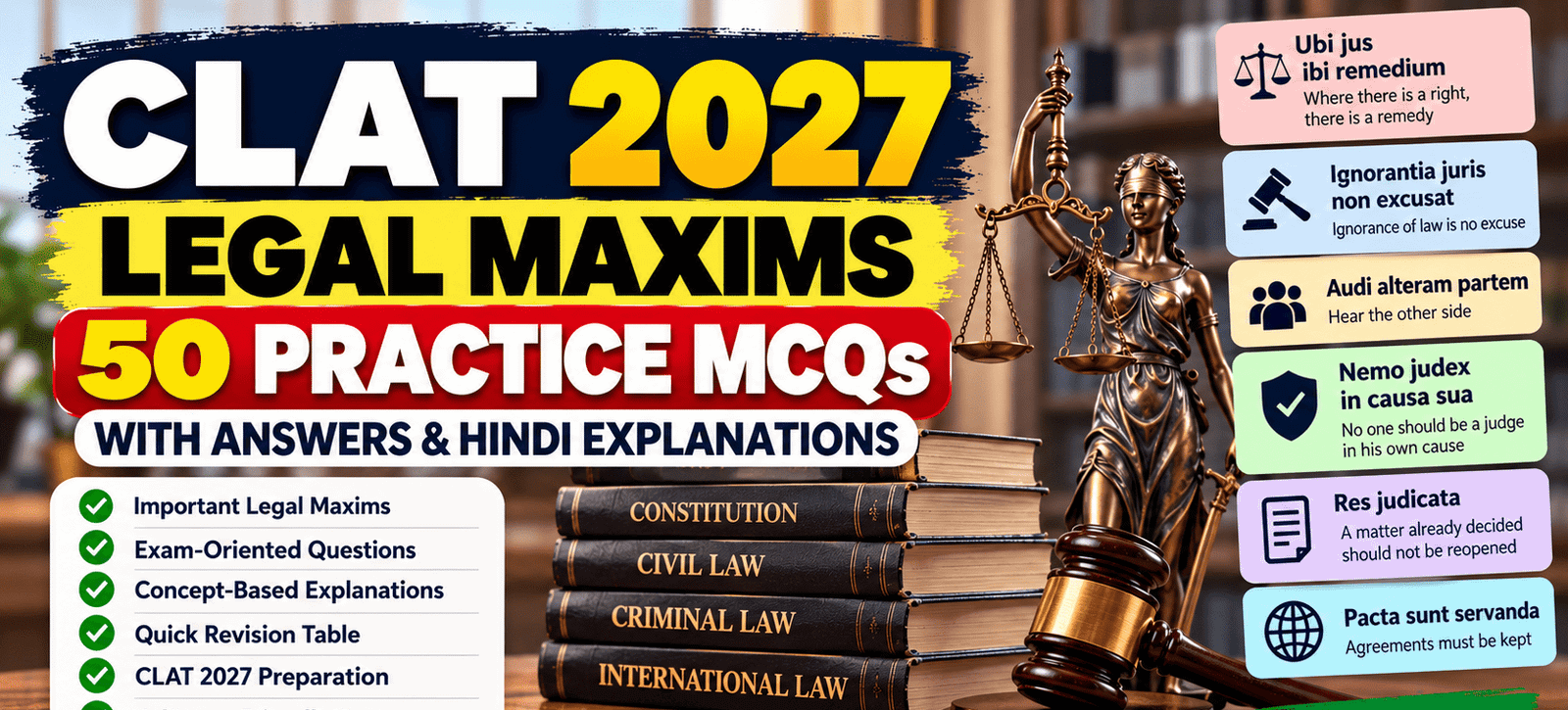
chapter 6 || CLAT 2027 || Legal Maxims Questions: 50 MCQs with Answers & Hindi Explanations
Legal Maxims क्या होते हैं?
Legal Maxims छोटे और established legal principles या expressions होते हैं, जिनका उपयोग किसी legal principle को संक्षेप में समझाने के लिए किया जाता है।
CLAT में maxim-based question देखते समय तीन steps follow करें:
- Maxim का meaning समझें।
- Question में दिए facts पहचानें।
- उस maxim के principle को facts पर apply करें।
यही approach केवल Latin translation याद करने से ज्यादा उपयोगी है।
CLAT 2027 Legal Maxims: Practice Questions
Q1. What does the legal maxim “Ubi jus ibi remedium” mean?
A. Where there is a right, there is a remedy
B. No one is above the law
C. Let the buyer beware
D. An act does not make a person guilty unless the mind is also guilty
Correct Answer: A. Where there is a right, there is a remedy
Explanation: इसका basic meaning है कि जहां legally recognized right है, वहां उसके violation के लिए appropriate legal remedy उपलब्ध हो सकती है।
Q2. A’s legally protected right is violated by B. A approaches the court seeking an appropriate legal remedy. Which maxim is most relevant?
A. Ubi jus ibi remedium
B. Caveat emptor
C. Volenti non fit injuria
D. Res ipsa loquitur
Answer: A. Ubi jus ibi remedium
Explanation: Situation directly right और remedy के relationship से जुड़ी है।
Q3. What does “Ignorantia juris non excusat” mean?
A. Ignorance of law is no excuse
B. Facts speak for themselves
C. Let the buyer beware
D. No damage without injury
Answer: A. Ignorance of law is no excuse
Explanation: केवल यह कहना कि “मुझे कानून पता नहीं था” सामान्यतः legal responsibility से बचने के लिए पर्याप्त नहीं होता।
Q4. A violates a legal rule and argues that he should not be liable because he did not know about the law. Which maxim is relevant?
A. Ignorantia juris non excusat
B. Actus non facit reum nisi mens sit rea
C. Res ipsa loquitur
D. Audi alteram partem
Answer: A. Ignorantia juris non excusat
Explanation: यहां defence law की ignorance पर आधारित है। इसलिए यह maxim relevant है।
Q5. What does “Ignorantia facti excusat” generally mean?
A. Ignorance of fact may excuse in appropriate circumstances
B. Ignorance of law is never relevant
C. Everyone is presumed guilty
D. The buyer must always beware
Answer: A. Ignorance of fact may excuse in appropriate circumstances
Explanation: Law की ignorance और fact की mistake अलग concepts हैं। कुछ परिस्थितियों में genuine mistake of fact legal liability को प्रभावित कर सकती है।
Q6. A honestly and reasonably believes that a particular factual circumstance exists, but that belief is wrong. Which maxim may become relevant?
A. Ignorantia facti excusat
B. Caveat emptor
C. Res judicata
D. Nemo judex in causa sua
Answer: A. Ignorantia facti excusat
Explanation: यहां issue factual mistake का है। इसलिए mistake of fact वाला principle relevant हो सकता है।
Q7. What does “Actus non facit reum nisi mens sit rea” mean?
A. An act does not make a person guilty unless there is also a guilty mind
B. The buyer must beware
C. Let the decision stand
D. No one should be a judge in their own case
Answer: A. An act does not make a person guilty unless there is also a guilty mind
Explanation: यह criminal law के basic principle से जुड़ा है। हालांकि specific offences में statutory exceptions और strict-liability rules हो सकते हैं।
Q8. A person accidentally breaks a window without any relevant criminal mental element. Which principle may become relevant?
A. Actus non facit reum nisi mens sit rea
B. Caveat emptor
C. Res judicata
D. Ratio decidendi
Answer: A. Actus non facit reum nisi mens sit rea
Explanation: Facts में accidental conduct और relevant guilty mental element की absence बताई गई है।
Q9. What does “Actus reus” generally refer to?
A. The physical element of an offence
B. The guilty mind only
C. A civil remedy
D. A contractual promise
Answer: A. The physical element of an offence
Explanation: Actus reus को broadly offence के physical element के रूप में समझा जाता है।
Q10. What does “Mens rea” generally refer to?
A. The mental element required for an offence
B. The physical act only
C. A civil contract
D. A court order
Answer: A. The mental element required for an offence
Explanation: Mens rea offence से जुड़ी required mental state को refer करता है, जैसे intention या knowledge।
Q11. What does “Res ipsa loquitur” mean?
A. The thing speaks for itself
B. Let the buyer beware
C. No one is above the law
D. The law does not concern itself with trifles
Answer: A. The thing speaks for itself
Explanation: यह negligence के context में इस्तेमाल होने वाला principle है। कुछ circumstances में accident की nature negligence की inference support कर सकती है।
Q12. A surgical instrument is left inside a patient’s body after an operation, and the circumstances strongly suggest negligence. Which maxim may be relevant?
A. Res ipsa loquitur
B. Caveat emptor
C. Audi alteram partem
D. Pacta sunt servanda
Answer: A. Res ipsa loquitur
Explanation: दिए गए facts में घटना की nature negligence की strong inference दे सकती है।
Q13. What does “Volenti non fit injuria” mean?
A. No injury is done to one who consents
B. Ignorance of law is no excuse
C. The thing speaks for itself
D. Where there is a right, there is a remedy
Answer: A. No injury is done to one who consents
Explanation: इसका basic idea voluntary acceptance of risk से जुड़ा है।
Q14. A voluntarily participates in a clearly understood risky activity after being informed of its ordinary risks. An ordinary risk materializes. Which maxim may be relevant?
A. Volenti non fit injuria
B. Res judicata
C. Nemo judex in causa sua
D. Ignorantia juris non excusat
Answer: A. Volenti non fit injuria
Explanation: व्यक्ति ने risk को समझकर voluntarily participate किया था।
Q15. Which statement about “Volenti non fit injuria” is most accurate?
A. Mere knowledge of a risk is not necessarily the same as voluntary consent to accept it
B. Every injured person automatically consented
C. Consent is never relevant in tort
D. The maxim applies only to contracts
Answer: A
Explanation: Risk के बारे में knowledge और उस risk को voluntarily accept करना हमेशा एक ही बात नहीं होती।
Q16. What does “Damnum sine injuria” mean?
A. Damage without legal injury
B. Legal injury without any damage
C. The thing speaks for itself
D. No one is above the law
Answer: A. Damage without legal injury
Explanation: Actual loss हो सकता है, लेकिन यदि कोई legally protected right violate नहीं हुआ, तो legal remedy जरूरी नहीं कि उपलब्ध हो।
Q17. A business loses customers because a competitor opens a lawful shop nearby. Which maxim may be relevant?
A. Damnum sine injuria
B. Injuria sine damno
C. Res ipsa loquitur
D. Audi alteram partem
Answer: A. Damnum sine injuria
Explanation: Financial loss हुआ, लेकिन दिए गए facts में competitor का lawful conduct किसी legal right का violation नहीं करता।
Q18. What does “Injuria sine damno” mean?
A. Legal injury without actual damage
B. Damage without legal injury
C. No injury to a consenting person
D. Ignorance of fact
Answer: A. Legal injury without actual damage
Explanation: Legally protected right का violation हो सकता है, भले actual monetary loss साबित न हो।
Q19. A person is unlawfully prevented from exercising a legal right, but cannot prove financial loss. Which maxim may support the claim?
A. Injuria sine damno
B. Damnum sine injuria
C. Caveat emptor
D. Res ipsa loquitur
Answer: A. Injuria sine damno
Explanation: यहां legal right का violation है, लेकिन financial loss साबित नहीं हुआ।
Q20. What does “Caveat emptor” mean?
A. Let the buyer beware
B. Let the seller beware
C. The thing speaks for itself
D. No one is above the law
Answer: A. Let the buyer beware
Explanation: Buyer को purchase करते समय goods की quality और suitability के बारे में उचित सावधानी रखनी चाहिए, subject to applicable legal exceptions.
Q21. A buyer has a reasonable opportunity to inspect goods but fails to do so. An obvious defect is later discovered. Which maxim may be relevant?
A. Caveat emptor
B. Res judicata
C. Volenti non fit injuria
D. Nemo judex in causa sua
Answer: A. Caveat emptor
Explanation: Buyer के पास inspection का reasonable opportunity था लेकिन उसने सावधानी नहीं बरती।
Q22. What does “Audi alteram partem” mean?
A. Hear the other side
B. Let the buyer beware
C. No one is above the law
D. The thing speaks for itself
Answer: A. Hear the other side
Explanation: यह natural justice का महत्वपूर्ण principle है। Adverse decision से पहले affected person को अपना पक्ष रखने का reasonable opportunity दिया जाना चाहिए, जहां principle लागू होता है।
Q23. A university plans to cancel a student’s admission for alleged misconduct without giving the student an opportunity to respond. Which maxim is most relevant?
A. Audi alteram partem
B. Caveat emptor
C. Damnum sine injuria
D. Res ipsa loquitur
Answer: A. Audi alteram partem
Explanation: Student को adverse action से पहले अपना पक्ष रखने का opportunity नहीं दिया गया।
Q24. What does “Nemo judex in causa sua” mean?
A. No one should be a judge in his or her own cause
B. Let the buyer beware
C. Where there is a right, there is a remedy
D. Ignorance of law is no excuse
Answer: A. Nemo judex in causa sua
Explanation: Decision-maker को ऐसी situation से बचना चाहिए जहां उसका personal interest outcome से जुड़ा हो।
Q25. A disciplinary committee member has a significant financial interest in a company involved in the dispute. Which principle is relevant?
A. Nemo judex in causa sua
B. Caveat emptor
C. Volenti non fit injuria
D. Res ipsa loquitur
Answer: A. Nemo judex in causa sua
Explanation: Personal financial interest bias की reasonable concern पैदा कर सकता है।
Q26. Which pair correctly represents two major principles of natural justice?
A. Audi alteram partem and Nemo judex in causa sua
B. Caveat emptor and Res ipsa loquitur
C. Damnum sine injuria and Caveat emptor
D. Volenti and Mens rea
Answer: A
Explanation: Natural justice के दो classic principles हैं—hearing the other side और absence of bias।
Q27. What does “Res judicata” generally mean?
A. A matter already judicially decided should not be reopened where the doctrine applies
B. The thing speaks for itself
C. Let the buyer beware
D. Hear the other side
Answer: A.
Explanation: इसका purpose repeated litigation को रोकना है, जब applicable legal requirements satisfy हों।
Q28. A and B litigate a matter before a competent court. The court finally decides the issue. B later attempts to reopen the same matter despite the conditions for res judicata being satisfied. Which doctrine is relevant?
A. Res judicata
B. Caveat emptor
C. Volenti non fit injuria
D. Res ipsa loquitur
Answer: A. Res judicata
Q29. What does “Stare decisis” generally mean?
A. To stand by decided cases
B. Let the buyer beware
C. Hear the other side
D. The thing speaks for itself
Answer: A. To stand by decided cases
Explanation: यह precedent-based legal system में consistency का महत्वपूर्ण principle है।
Q30. Why is the doctrine of stare decisis important?
A. It promotes consistency and predictability in judicial decisions
B. It makes every case identical
C. It removes the role of legislation
D. It prevents all appeals
Answer: A
Q31. What does “Ratio decidendi” mean?
A. The legal principle or reasoning on which a judicial decision is based
B. Every statement made by a judge
C. The final punishment only
D. The facts of every case
Answer: A. Ratio decidendi
Explanation: यह वह legal principle है जो decision के लिए necessary था और precedent में महत्वपूर्ण हो सकता है।
Q32. What is “Obiter dicta”?
A. Statements or observations made by a court that are not essential to the decision
B. The binding legal rule in every case
C. A statutory definition
D. A contractual term
Answer: A. Obiter dicta
Q33. A judge decides a case based on a particular legal principle. Another judge later relies on that essential principle. What is the first principle called?
A. Ratio decidendi
B. Obiter dicta
C. Caveat emptor
D. Damnum sine injuria
Answer: A. Ratio decidendi
Q34. A judge makes an additional observation about a hypothetical future situation that was not necessary for deciding the case. What is it?
A. Obiter dicta
B. Ratio decidendi
C. Res judicata
D. Mens rea
Answer: A. Obiter dicta
Q35. What does “Pacta sunt servanda” generally mean?
A. Agreements must be kept
B. Let the buyer beware
C. The thing speaks for itself
D. No one is above the law
Answer: A. Agreements must be kept
Q36. A and B enter into a valid contract. A later refuses to perform merely because he changed his mind. Which maxim supports the principle that contractual promises should be honored?
A. Pacta sunt servanda
B. Audi alteram partem
C. Res ipsa loquitur
D. Nemo judex in causa sua
Answer: A. Pacta sunt servanda
Q37. What does “Nemo dat quod non habet” mean?
A. No one can give what they do not have
B. Let the buyer beware
C. The thing speaks for itself
D. No one is above the law
Answer: A. Nemo dat quod non habet
Explanation: सामान्यतः व्यक्ति उतना ही title transfer कर सकता है जितना उसके पास स्वयं है, subject to legal exceptions।
Q38. A does not own a particular car but falsely sells it to B claiming to be the owner. Which maxim may become relevant?
A. Nemo dat quod non habet
B. Audi alteram partem
C. Volenti non fit injuria
D. Res judicata
Answer: A. Nemo dat quod non habet
Q39. What does “Actio personalis moritur cum persona” traditionally express?
A. A personal action may, in traditional common-law principle, die with the person
B. The buyer must beware
C. Agreements must always be kept
D. No one is above the law
Answer: A
Explanation: यह traditional maxim है। Modern law में statutes और exceptions को ध्यान में रखना जरूरी है।
Q40. What does “De minimis non curat lex” mean?
A. The law does not concern itself with trifles
B. Ignorance of law is no excuse
C. The buyer must beware
D. No one should be a judge in his own cause
Answer: A. De minimis non curat lex
Q41. A person complains about an extremely insignificant technical inconvenience that causes no meaningful legal harm. Which maxim may be relevant?
A. De minimis non curat lex
B. Ubi jus ibi remedium
C. Pacta sunt servanda
D. Nemo dat quod non habet
Answer: A. De minimis non curat lex
Principle-Based Legal Maxim Questions
CLAT में केवल direct-definition questions ही नहीं, बल्कि Principle + Fact + Application format भी महत्वपूर्ण है। इसलिए नीचे ऐसे practice questions दिए गए हैं।
Q42. Principle
Where there is a legally recognized right, the law may provide an appropriate remedy for its violation.
Fact: A’s legally protected property right is unlawfully interfered with by B.
Which maxim best applies?
A. Ubi jus ibi remedium
B. Caveat emptor
C. Volenti non fit injuria
D. Res ipsa loquitur
Answer: A. Ubi jus ibi remedium
Explanation: Legally protected right में unlawful interference हुआ है। इसलिए right और remedy का principle relevant है।
Q43. Principle
A person should be given an opportunity to be heard before an adverse decision is taken against them, where natural justice applies.
Fact: A government authority cancels X’s licence without giving X an opportunity to respond.
A. Audi alteram partem
B. Nemo dat quod non habet
C. Caveat emptor
D. Damnum sine injuria
Answer: A. Audi alteram partem
Q44. Principle
A decision-maker should not decide a matter where they have a personal interest creating a legally significant risk of bias.
Fact: A committee member is asked to decide a dispute involving the member’s own financial interest.
A. Nemo judex in causa sua
B. Res judicata
C. Caveat emptor
D. Volenti non fit injuria
Answer: A. Nemo judex in causa sua
Q45. Principle
A person who voluntarily accepts a known risk may, in appropriate circumstances, be unable to complain about ordinary consequences of that risk.
Fact: B knowingly participates in a properly organized high-risk sporting activity after being informed of ordinary risks.
A. Volenti non fit injuria
B. Injuria sine damno
C. Res judicata
D. Ignorantia juris non excusat
Answer: A. Volenti non fit injuria
Q46. Consider the following statements:
- Caveat emptor means “let the buyer beware.”
- Audi alteram partem means “hear the other side.”
- Nemo judex in causa sua concerns impartial decision-making.
- Res ipsa loquitur means “agreements must be kept.”
Which option is correct?
A. Only 1 and 2
B. Only 1, 2 and 3
C. Only 2 and 4
D. All four
Answer: B. Only 1, 2 and 3
Explanation: Statement 4 गलत है। “Agreements must be kept” के लिए Pacta sunt servanda maxim है।
Q47. Consider the following statements:
- Ratio decidendi is the legal principle necessary for the decision.
- Obiter dicta are observations not essential to the decision.
- Stare decisis promotes consistency in judicial decisions.
- Res judicata means that every case must be decided twice.
Which option is correct?
A. Only 1 and 2
B. Only 1, 2 and 3
C. Only 2 and 4
D. All four
Answer: B. Only 1, 2 and 3
Q48. Match the following:
| Maxim | Meaning |
|---|---|
| 1. Ubi jus ibi remedium | a. Let the buyer beware |
| 2. Caveat emptor | b. Where there is a right, there is a remedy |
| 3. Res ipsa loquitur | c. The thing speaks for itself |
| 4. Pacta sunt servanda | d. Agreements must be kept |
A. 1-b, 2-a, 3-c, 4-d
B. 1-a, 2-b, 3-d, 4-c
C. 1-c, 2-d, 3-a, 4-b
D. 1-d, 2-c, 3-b, 4-a
Answer: A. 1-b, 2-a, 3-c, 4-d
Q49. Match the following:
| Maxim | Meaning |
|---|---|
| 1. Damnum sine injuria | a. Hear the other side |
| 2. Injuria sine damno | b. Damage without legal injury |
| 3. Audi alteram partem | c. No one should be judge in own cause |
| 4. Nemo judex in causa sua | d. Legal injury without actual damage |
A. 1-b, 2-d, 3-a, 4-c
B. 1-d, 2-b, 3-c, 4-a
C. 1-a, 2-c, 3-b, 4-d
D. 1-c, 2-a, 3-d, 4-b
Answer: A. 1-b, 2-d, 3-a, 4-c
Exam Tip: Damnum sine injuria और Injuria sine damno को आपस में confuse न करें।
Q50. What is the best way to approach a Legal Maxim question in CLAT?
A. Memorize only the Latin words
B. Identify the meaning of the maxim and apply its principle to the facts
C. Select the longest option
D. Ignore the facts and choose the most familiar maxim
Correct Answer: B. Identify the meaning of the maxim and apply its principle to the facts
Explanation: CLAT में केवल Latin translation याद करना पर्याप्त नहीं है। पहले maxim का meaning समझें, फिर दिए गए facts में उसका legal principle identify करें।
Quick Revision: Important Legal Maxims
| Legal Maxim | Simple Meaning |
|---|---|
| Ubi jus ibi remedium | Where there is a right, there is a remedy |
| Ignorantia juris non excusat | Ignorance of law is no excuse |
| Ignorantia facti excusat | Mistake of fact may excuse |
| Actus non facit reum nisi mens sit rea | Act + guilty mind principle |
| Actus reus | Physical element of an offence |
| Mens rea | Mental element of an offence |
| Res ipsa loquitur | The thing speaks for itself |
| Volenti non fit injuria | Consent to known risk |
| Damnum sine injuria | Damage without legal injury |
| Injuria sine damno | Legal injury without actual damage |
| Caveat emptor | Let the buyer beware |
| Audi alteram partem | Hear the other side |
| Nemo judex in causa sua | No one should judge their own cause |
| Res judicata | Matter already judicially decided |
| Stare decisis | Stand by decided cases |
| Ratio decidendi | Legal principle necessary for decision |
| Obiter dicta | Non-essential judicial observations |
| Pacta sunt servanda | Agreements must be kept |
| Nemo dat quod non habet | No one can give what they do not have |
| De minimis non curat lex | Law does not concern itself with trifles |
CLAT Legal Maxims को कैसे याद करें?
सिर्फ Latin words को रटने के बजाय उन्हें concept groups में याद करें।
Rights & Remedies
- Ubi jus ibi remedium
- Damnum sine injuria
- Injuria sine damno
Criminal Law
- Actus reus
- Mens rea
- Actus non facit reum nisi mens sit rea
Natural Justice
- Audi alteram partem
- Nemo judex in causa sua
Judicial Decisions
- Res judicata
- Stare decisis
- Ratio decidendi
- Obiter dicta
Contract & Property
- Pacta sunt servanda
- Nemo dat quod non habet
Tort
- Res ipsa loquitur
- Volenti non fit injuria
- Caveat emptor