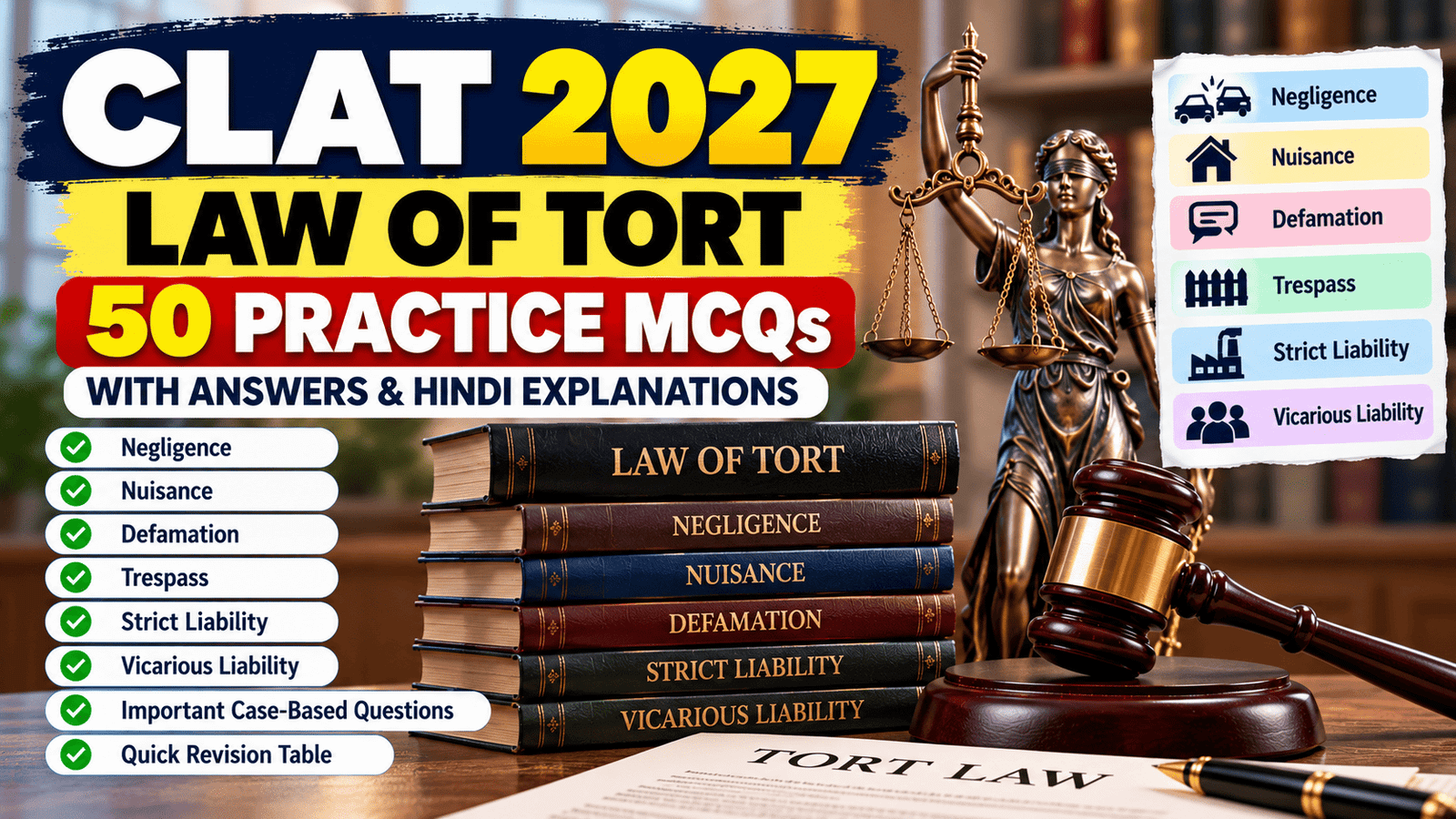
CLAT 2027 Law of Tort Questions: 50 MCQs with Answers & Hindi Explanations
Law of Tort CLAT Legal Reasoning का एक महत्वपूर्ण topic है। इस topic में students को civil wrongs, negligence, nuisance, defamation, trespass, strict liability और vicarious liability जैसे concepts को समझना होता है।
इस practice set में 50 CLAT-oriented Law of Tort MCQs दिए गए हैं। हर question के साथ correct answer और आसान Hindi explanation दी गई है, ताकि आप concept को समझकर questions solve कर सकें।
- Topic: Law of Tort
- Exam: CLAT 2027
- Questions: 50 MCQs
- Format: Principle + Fact Based Questions
- Language: Easy English + Hindi Explanations
Law of Tort क्या है?
Tort सामान्यतः एक civil wrong है। इसमें किसी व्यक्ति के legally protected right या interest को नुकसान पहुंच सकता है और applicable law के अनुसार appropriate remedy उपलब्ध हो सकती है।
CLAT Legal Reasoning में Tort पढ़ते समय केवल definitions याद करना पर्याप्त नहीं है। आपको यह समझना चाहिए कि किसी situation में कौन-सा legal principle लागू होगा और facts के आधार पर conclusion कैसे निकलेगा।
CLAT 2027 में Law of Tort के Important Topics
- Tort and Civil Wrong
- Negligence
- Duty of Care
- Breach of Duty
- Foreseeability
- Causation
- Damages
- Nuisance
- Defamation
- Trespass to Land
- Trespass to Person
- Assault
- Battery
- False Imprisonment
- Strict Liability
- Rylands v Fletcher
- Vicarious Liability
- Civil Remedies
CLAT 2027 Law of Tort MCQs
Q1. What is a tort?
A. A criminal offence in every case
B. A civil wrong for which the law may provide a remedy
C. A valid contract
D. A legislative Act
Correct Answer: B. A civil wrong for which the law may provide a remedy
Explanation: Tort सामान्यतः एक civil wrong है। इसमें किसी व्यक्ति के legally protected right या interest को नुकसान पहुंच सकता है और applicable law appropriate remedy provide कर सकता है।
Q2. Which of the following best distinguishes a tort from a breach of contract?
A. A tort generally arises from a duty imposed by law, while a contract arises from an agreement between parties
B. A tort is always criminal
C. A contract can never create legal obligations
D. There is no difference
Correct Answer: A. A tort generally arises from a duty imposed by law, while a contract arises from an agreement between parties
Explanation: Tort में duty सामान्यतः कानून द्वारा impose होती है, जबकि contract में obligation parties के agreement से आती है। दोनों civil liability पैदा कर सकते हैं, लेकिन उनका legal basis अलग होता है।
Q3. Which of the following is generally an essential element of tortious liability?
A. A wrongful act or omission causing legally recognized harm
B. Friendship between parties
C. A written agreement in every case
D. Criminal intention in every case
Correct Answer: A. A wrongful act or omission causing legally recognized harm
Explanation: Tortious liability में wrongful act या omission और उससे जुड़ा legally recognized injury या harm important हो सकता है। हर tort में criminal intention जरूरी नहीं होती।
Q4. A driver carelessly drives a vehicle and injures a pedestrian. Which area of law is most directly relevant?
A. Law of Tort
B. Contract law only
C. Constitutional amendment
D. Company law only
Correct Answer: A. Law of Tort
Explanation: Driver की careless conduct से pedestrian को injury हुई। यह negligence-based tortious liability का example हो सकता है।
Q5. What is negligence?
A. Intentional performance of every act
B. Failure to exercise the reasonable care expected in the circumstances
C. A valid contract
D. A legislative procedure
Correct Answer: B. Failure to exercise the reasonable care expected in the circumstances
Explanation: Negligence का मतलब ऐसी reasonable care न लेना है जो circumstances में एक reasonable person से expected हो सकती है। इससे दूसरे व्यक्ति को legally recognized harm हो सकता है।
Q6. Which of the following is most closely associated with negligence?
A. Duty of care
B. Parliamentary election
C. Consideration
D. Offer and acceptance
Correct Answer: A. Duty of care
Explanation: Negligence establish करने में duty of care important concept है। यह देखना होता है कि defendant पर claimant के प्रति reasonable care की legal duty थी या नहीं।
Q7. A doctor treats a patient but fails to take precautions that a reasonably competent doctor would ordinarily take, causing injury. Which principle is most relevant?
A. Negligence
B. Trespass to land
C. Defamation
D. Nuisance only
Correct Answer: A. Negligence
Explanation: Doctor से circumstances के अनुसार reasonable professional care की अपेक्षा हो सकती है। Required standard of care का पालन न करने से injury होने पर negligence का issue arise हो सकता है।
Q8. What is meant by “duty of care”?
A. A legal obligation to take reasonable care to avoid foreseeable harm to persons who may be affected
B. A social promise between friends
C. A criminal punishment
D. A contractual price
Correct Answer: A. A legal obligation to take reasonable care to avoid foreseeable harm to persons who may be affected
Explanation: Duty of care का मतलब है कि जहां law ऐसी duty recognize करता है, वहां व्यक्ति को foreseeable harm से बचने के लिए reasonable precautions लेने चाहिए।
Q9. A shopkeeper leaves a slippery substance on the entrance floor without warning customers. A customer slips and is injured. What is the strongest legal issue?
A. Negligence
B. Consideration
C. Defamation
D. Novation
Correct Answer: A. Negligence
Explanation: Shopkeeper को customers की safety के लिए reasonable precautions लेने चाहिए। बिना warning slippery floor छोड़ना और उससे injury होना negligence का strong example हो सकता है।
Q10. What is “breach of duty” in negligence?
A. Failure to meet the required standard of care
B. Making an offer
C. Accepting an offer
D. Publishing legislation
Correct Answer: A. Failure to meet the required standard of care
Explanation: जब defendant पर duty of care थी लेकिन उसने expected standard of care maintain नहीं किया, तो breach of duty हो सकता है।
Q11. What does “foreseeability” generally mean in negligence law?
A. Whether the type of harm could reasonably have been anticipated
B. Whether the defendant is wealthy
C. Whether the victim signed a contract
D. Whether the conduct was popular
Correct Answer: A. Whether the type of harm could reasonably have been anticipated
Explanation: Foreseeability में देखा जाता है कि circumstances में उस तरह का harm reasonably predictable था या नहीं। यह negligence और liability analysis में important हो सकता है।
Q12. A driver speeds through a crowded school zone. The driver hits a pedestrian. Was the risk of injury reasonably foreseeable?
A. Yes
B. No, because accidents are never foreseeable
C. No, because drivers have no duty
D. Only if the pedestrian signed a contract
Correct Answer: A. Yes
Explanation: Crowded school zone में तेज speed से driving करना obvious risk पैदा कर सकता है। Pedestrian injury की possibility reasonably foreseeable हो सकती है।
Q13. What is causation in tort law?
A. The connection between the defendant’s conduct and the harm suffered
B. The relationship between two contracts
C. The process of making legislation
D. The appointment of a judge
Correct Answer: A. The connection between the defendant’s conduct and the harm suffered
Explanation: Causation का मतलब यह establish करना है कि defendant की conduct और claimant के harm के बीच sufficient legal connection है।
Q14. A leaves a dangerous object on a public walkway. B trips over it and suffers injury. If B’s injury would not have occurred without A’s conduct, what concept is relevant?
A. Causation
B. Consideration
C. Privity
D. Acceptance
Correct Answer: A. Causation
Explanation: अगर A की conduct के बिना B को injury नहीं होती, तो factual causation का issue relevant है।
Q15. Which statement is generally correct about damages in tort?
A. Damages may be awarded to compensate for legally recognized harm
B. Damages are always criminal punishment
C. Damages are never monetary
D. Damages automatically punish every defendant with imprisonment
Correct Answer: A. Damages may be awarded to compensate for legally recognized harm
Explanation: Tort law में damages का मुख्य उद्देश्य legally recognized loss या harm के लिए compensation provide करना हो सकता है।
Q16. A negligently damages B’s property. B successfully establishes tortious liability. Which remedy may be relevant?
A. Damages
B. Criminal imprisonment in every case
C. Citizenship cancellation
D. Parliamentary dissolution
Correct Answer: A. Damages
Explanation: Property damage से हुए legally recoverable loss के लिए damages एक प्रमुख civil remedy हो सकती है।
Q17. What is nuisance?
A. Unlawful or unreasonable interference with a person’s use or enjoyment of land or certain public rights
B. Every breach of contract
C. Every criminal offence
D. A legislative debate
Correct Answer: A. Unlawful or unreasonable interference with a person’s use or enjoyment of land or certain public rights
Explanation: Nuisance में unreasonable interference important है। Private nuisance property के use या enjoyment को प्रभावित कर सकता है, जबकि public nuisance public rights को affect कर सकता है।
Q18. A factory continuously produces extremely loud noise that substantially interferes with a neighbour’s reasonable enjoyment of their home. Which tort may be relevant?
A. Nuisance
B. Defamation
C. False imprisonment
D. Conversion
Correct Answer: A. Nuisance
Explanation: Continuous excessive noise neighbour के property enjoyment में unreasonable interference कर सकता है। इसलिए nuisance का principle relevant है।
Q19. What is private nuisance primarily concerned with?
A. Unreasonable interference with a person’s use or enjoyment of land
B. Damage to reputation only
C. Physical attack only
D. Breach of every contract
Correct Answer: A. Unreasonable interference with a person’s use or enjoyment of land
Explanation: Private nuisance का focus generally land के use और enjoyment में unreasonable interference पर होता है।
Q20. What is public nuisance primarily concerned with?
A. Interference with a right common to the public
B. A dispute between two contracting parties only
C. Damage to one person’s reputation only
D. A private gift
Correct Answer: A. Interference with a right common to the public
Explanation: Public nuisance में ऐसा interference होता है जो public या community के common right को affect करता है।
Q21. What is defamation?
A. Publication of a false statement that harms another person’s reputation, subject to applicable legal requirements and defences
B. Every criticism of a person
C. Every private disagreement
D. A breach of contract
Correct Answer: A. Publication of a false statement that harms another person’s reputation, subject to applicable legal requirements and defences
Explanation: Defamation में reputation को harm करने वाली false statement का publication important element हो सकता है। Truth, privilege और अन्य applicable defences भी relevant हो सकते हैं।
Q22. A publishes a knowingly false statement about B, causing people to think badly of B. Which tort may be involved?
A. Defamation
B. Nuisance
C. Trespass to land
D. Negligence only
Correct Answer: A. Defamation
Explanation: A ने knowingly false statement publish की और B की reputation को नुकसान हुआ। इसलिए defamation का issue arise हो सकता है।
Q23. Which of the following is generally NOT enough by itself to establish defamation?
A. A statement that is merely an opinion, depending on its nature and context
B. Publication to a third party
C. A statement concerning the claimant
D. Reputational harm where legally required
Correct Answer: A. A statement that is merely an opinion, depending on its nature and context
Explanation: हर opinion automatically defamation नहीं बनती। Statement की nature, context, truth, privilege और applicable law देखना जरूरी है।
Q24. What is trespass to land?
A. Direct and unauthorized interference with another person’s possession of land
B. Breach of a promise
C. Damage to reputation
D. Failure to pay a debt
Correct Answer: A. Direct and unauthorized interference with another person’s possession of land
Explanation: Trespass to land में किसी दूसरे व्यक्ति के land possession में direct और unauthorized interference होता है।
Q25. A intentionally enters B’s private property without permission. Which tort may be involved?
A. Trespass to land
B. Defamation
C. Nuisance only
D. Negligence only
Correct Answer: A. Trespass to land
Explanation: B की property में बिना permission direct entry trespass to land का classic example हो सकती है।
Q26. A throws an object onto B’s property without permission. Even if A does not enter personally, what tort may potentially arise?
A. Trespass to land
B. Defamation
C. Breach of contract
D. Fraud
Correct Answer: A. Trespass to land
Explanation: Trespass केवल personal entry तक limited नहीं है। किसी object को directly दूसरे की land पर place करना भी unauthorized interference का issue पैदा कर सकता है।
Q27. What is trespass to the person?
A. Direct and unlawful interference with another person’s body or personal liberty
B. Interference with a contract
C. Interference with legislation
D. Damage to a building only
Correct Answer: A. Direct and unlawful interference with another person’s body or personal liberty
Explanation: Trespass to person में individual’s body या personal liberty में direct unlawful interference शामिल हो सकता है। Assault, battery और false imprisonment इसके important categories हैं।
Q28. What is assault in tort law generally concerned with?
A. Creating a reasonable apprehension of imminent unlawful physical contact
B. Actual damage to property only
C. Publishing false information
D. Breaking a contract
Correct Answer: A. Creating a reasonable apprehension of imminent unlawful physical contact
Explanation: Assault में actual physical contact जरूरी नहीं होता। Conduct से imminent unlawful physical contact का reasonable apprehension पैदा हो सकता है।
Q29. A raises his fist and moves aggressively toward B as if about to strike him, causing B to reasonably fear immediate physical contact. Which tort may be involved?
A. Assault
B. Nuisance
C. Defamation
D. Conversion
Correct Answer: A. Assault
Explanation: B को immediate unlawful physical contact का reasonable fear हुआ। इसलिए assault का principle apply हो सकता है, भले actual hit न हुआ हो।
Q30. What is battery generally concerned with?
A. Intentional and unlawful physical contact with another person
B. Damage to reputation
C. Interference with land only
D. Breach of a contract
Correct Answer: A. Intentional and unlawful physical contact with another person
Explanation: Battery में unlawful physical contact important है। हर physical contact battery नहीं होता; consent, lawful justification और circumstances भी relevant हो सकते हैं।
Q31. A intentionally pushes B during an argument without lawful justification. Which tort may arise?
A. Battery
B. Nuisance
C. Defamation
D. Breach of contract
Correct Answer: A. Battery
Explanation: A ने intentionally physical contact किया और कोई lawful justification नहीं बताया गया। इसलिए battery का issue arise हो सकता है।
Q32. What is false imprisonment?
A. Unlawful restraint of a person’s freedom of movement
B. Damage to reputation
C. Damage to land
D. Failure to perform a contract
Correct Answer: A. Unlawful restraint of a person’s freedom of movement
Explanation: False imprisonment में व्यक्ति की freedom of movement को unlawful तरीके से restrain किया जाता है। Physical force हमेशा necessary नहीं होती।
Q33. A security guard locks a customer inside a room without lawful justification and refuses to let the customer leave. Which tort may be involved?
A. False imprisonment
B. Defamation
C. Nuisance
D. Trespass to land only
Correct Answer: A. False imprisonment
Explanation: Customer की freedom of movement को deliberately restrict किया गया है। अगर कोई lawful justification नहीं है, तो false imprisonment का issue arise हो सकता है।
Q34. What is strict liability?
A. Liability that may arise without requiring proof of negligence in certain circumstances
B. Liability that always requires criminal intention
C. Liability arising only from contracts
D. Liability that never allows defences
Correct Answer: A. Liability that may arise without requiring proof of negligence in certain circumstances
Explanation: Strict liability में claimant को हर बार defendant की negligence prove करने की जरूरत नहीं होती। Certain dangerous activities में law special liability impose कर सकता है, subject to applicable principles and defences।
Q35. Under the traditional rule in Rylands v Fletcher, what is an important idea?
A. A person who brings and keeps a dangerous thing on land may be liable if it escapes and causes damage, subject to recognized requirements and exceptions
B. Every accident creates liability
C. Every contract is void
D. Every nuisance is criminal
Correct Answer: A. A person who brings and keeps a dangerous thing on land may be liable if it escapes and causes damage, subject to recognized requirements and exceptions
Explanation: Traditional strict liability principle में dangerous thing को land पर accumulate करना और उसका escape होकर damage करना important elements हैं। यह automatic liability for every accident नहीं है।
Q36. A stores a large quantity of a dangerous substance on his land. The substance escapes and damages B’s property. Under the traditional strict liability principle, what issue is most relevant?
A. Whether the requirements of strict liability are satisfied
B. Whether B accepted an offer
C. Whether A made a contract with B
D. Whether B defamed A
Correct Answer: A. Whether the requirements of strict liability are satisfied
Explanation: Dangerous substance, accumulation और escape के facts मौजूद हैं। अब देखना होगा कि traditional strict liability के legal requirements और applicable exceptions क्या हैं।
Q37. Which statement about strict liability is most accurate?
A. It does not mean liability in every accident
B. It means every person is liable for every injury
C. It applies only to contracts
D. It eliminates all legal defences
Correct Answer: A. It does not mean liability in every accident
Explanation: Strict liability का मतलब unlimited liability नहीं है। Specific legal conditions और recognized exceptions apply हो सकते हैं।
Q38. What is vicarious liability?
A. Liability of one person for the tortious act of another because of a recognized legal relationship
B. Liability only for one’s own criminal intention
C. Liability under every contract
D. Liability for every accident
Correct Answer: A. Liability of one person for the tortious act of another because of a recognized legal relationship
Explanation: Vicarious liability में एक व्यक्ति दूसरे के wrongful act के लिए liable हो सकता है, जैसे employer-employee relationship में, यदि applicable legal requirements पूरी हों।
Q39. An employee negligently injures a customer while performing assigned work for the employer. Which principle may make the employer liable?
A. Vicarious liability
B. Defamation
C. Consideration
D. Privity
Correct Answer: A. Vicarious liability
Explanation: Employee ने assigned employment के दौरान negligent act किया। ऐसे circumstances में employer पर vicarious liability arise हो सकती है, subject to legal requirements।
Q40. Which condition is particularly relevant to vicarious liability?
A. Whether the wrongful act occurred in the course of employment
B. Whether the employee and employer are relatives
C. Whether the employee is wealthy
D. Whether the victim signed a contract
Correct Answer: A. Whether the wrongful act occurred in the course of employment
Explanation: Employer liability के लिए यह महत्वपूर्ण है कि employee का wrongful act employment के course या scope से sufficiently connected था या नहीं।
Principle-Based Law of Tort Questions
CLAT Legal Reasoning में कई questions principle और facts को जोड़कर पूछे जाते हैं। इसलिए नीचे application-based questions दिए गए हैं।
Q41. Principle-Based Question
Principle: A person may be liable for negligence if they owe a duty of care, breach that duty, and the breach causes legally recognized harm.
Fact: A drives at excessive speed in a crowded market despite knowing that pedestrians are nearby. A hits B, causing injury.
What is the best conclusion?
A. A may be liable for negligence
B. A cannot be liable because driving is always lawful
C. B must have a contract with A
D. No legal issue arises
Correct Answer: A. A may be liable for negligence
Explanation: A पर road users के प्रति reasonable care की duty हो सकती है। Excessive speed breach दिखाती है और उसी conduct से B को injury हुई, इसलिए negligence establish हो सकती है।
Q42. Principle-Based Question
Principle: Trespass to land involves direct and unauthorized interference with another’s possession of land.
Fact: A enters B’s fenced private garden without permission merely to take photographs.
What is the best conclusion?
A. A may be liable for trespass to land
B. A cannot be liable because no property was damaged
C. A automatically becomes the owner
D. The matter is necessarily contractual
Correct Answer: A. A may be liable for trespass to land
Explanation: Trespass के लिए actual property damage हमेशा जरूरी नहीं होता। Unauthorized direct entry itself legal issue पैदा कर सकती है, subject to lawful justification।
Q43. Principle-Based Question
Principle: False imprisonment involves unlawful restraint of a person’s freedom of movement.
Fact: A locks B inside an office and refuses to allow B to leave, without lawful authority.
What is the best conclusion?
A. A may be liable for false imprisonment
B. A is automatically protected because the office belongs to A
C. B has no legal right to leave
D. It is only a contract dispute
Correct Answer: A. A may be liable for false imprisonment
Explanation: B की freedom of movement को intentionally restrict किया गया और lawful authority नहीं है। इसलिए false imprisonment का principle apply हो सकता है।
Q44. Principle-Based Question
Principle: A person may be liable for nuisance where their conduct causes unreasonable interference with another person’s use or enjoyment of land.
Fact: A operates extremely loud machinery every night next to B’s home, substantially interfering with B’s ordinary enjoyment of the property.
What is the best conclusion?
A. A may be liable for nuisance
B. A cannot be liable because noise is never relevant
C. B must have purchased the machinery
D. The issue is necessarily defamation
Correct Answer: A. A may be liable for nuisance
Explanation: Continuous excessive noise B के property enjoyment में substantial and unreasonable interference कर रहा है। इसलिए private nuisance का issue arise हो सकता है।
Q45. Principle-Based Question
Principle: An employer may be vicariously liable for an employee’s tort committed in the course of employment.
Fact: A delivery employee negligently hits a pedestrian while making an assigned delivery for the employer.
What is the strongest conclusion?
A. The employer may be vicariously liable, subject to applicable requirements
B. The employer can never be liable for an employee’s acts
C. The pedestrian must have a contract with the employer
D. The employee automatically becomes a criminal offender
Correct Answer: A. The employer may be vicariously liable, subject to applicable requirements
Explanation: Employee assigned delivery कर रहा था और उसी दौरान negligence हुई। यह employment से sufficiently connected conduct हो सकती है, इसलिए employer की vicarious liability का issue उठ सकता है।
Q46. Consider the following statements:
1. Negligence may involve failure to exercise reasonable care.
2. Trespass to land concerns direct unauthorized interference with land possession.
3. Defamation concerns protection of reputation.
4. Every tort requires a written contract between the parties.
Which option is correct?
A. Only 1 and 2
B. Only 2 and 3
C. Only 1, 2 and 3
D. All four
Correct Answer: C. Only 1, 2 and 3
Explanation: Statements 1, 2 और 3 सही हैं। Tort के लिए written contract आवश्यक नहीं है। Tortious duties सामान्यतः law द्वारा imposed होती हैं।
Q47. Consider the following statements:
1. Strict liability may apply without proof of negligence in appropriate cases.
2. Vicarious liability can arise from a recognized legal relationship.
3. False imprisonment concerns unlawful restraint of movement.
4. Every physical contact is automatically battery.
Which option is correct?
A. Only 1 and 2
B. Only 1, 2 and 3
C. Only 2 and 4
D. All four
Correct Answer: B. Only 1, 2 and 3
Explanation: पहले तीन statements सही हैं। हर physical contact battery नहीं होता क्योंकि consent और lawful justification जैसे factors relevant हो सकते हैं।
Q48. Assertion and Reason
Assertion (A): An employer may sometimes be held liable for a tort committed by an employee.
Reason (R): The law may impose vicarious liability where the employee commits the wrongful act in the course of employment.
A. Both A and R are true, and R correctly explains A
B. Both A and R are true, but R does not explain A
C. A is true, but R is false
D. A is false, but R is true
Correct Answer: A. Both A and R are true, and R correctly explains A
Explanation: Vicarious liability का basic idea यही है। Recognized employer-employee relationship और course of employment के circumstances में employer liable हो सकता है।
Q49. A homeowner negligently leaves a dangerous hole uncovered on a pathway that visitors are reasonably expected to use. A visitor falls into it and suffers injury.
Which combination is most relevant?
A. Duty of care, breach and causation
B. Offer, acceptance and consideration
C. Privity and novation
D. Legislative purpose and delegated legislation
Correct Answer: A. Duty of care, breach and causation
Explanation: Homeowner पर circumstances के अनुसार reasonable care की duty हो सकती है। Hole को cover न करना breach हो सकता है और उसी के कारण injury हुई, तो causation भी establish हो सकती है।
Q50. Which statement best summarizes the Law of Tort for CLAT Legal Reasoning?
A. Tort law deals only with criminal punishment
B. Tort law primarily concerns civil wrongs and concepts such as negligence, nuisance, defamation, trespass and liability
C. Tort law applies only when there is a written contract
D. Tort law has no remedies
Correct Answer: B. Tort law primarily concerns civil wrongs and concepts such as negligence, nuisance, defamation, trespass and liability
Explanation: CLAT के लिए Tort को civil wrong के रूप में समझना सबसे important starting point है। इसके प्रमुख concepts में negligence, nuisance, defamation, trespass, strict liability, vicarious liability और remedies शामिल हैं।
Quick Revision: Law of Tort
| Concept | Quick Meaning |
|---|---|
| Tort | Civil wrong |
| Negligence | Failure to exercise reasonable care |
| Duty of Care | Legal duty to take reasonable care |
| Breach of Duty | Failure to meet required standard of care |
| Foreseeability | Whether harm could reasonably be anticipated |
| Causation | Connection between conduct and harm |
| Damages | Possible civil compensation |
| Nuisance | Unreasonable interference with relevant rights or property enjoyment |
| Defamation | Wrongful harm to reputation through actionable publication |
| Trespass to Land | Direct unauthorized interference with land possession |
| Assault | Reasonable apprehension of imminent unlawful contact |
| Battery | Unlawful physical contact |
| False Imprisonment | Unlawful restraint of freedom of movement |
| Strict Liability | Liability that may arise without proving negligence in appropriate cases |
| Rylands v Fletcher | Traditional strict liability principle involving escape of dangerous things, subject to requirements and exceptions |
| Vicarious Liability | Liability arising from a recognized legal relationship for another’s tort |
CLAT 2027 Law of Tort Questions कैसे Solve करें?
Principle-Fact based questions में इस sequence को follow करें:
इन concepts पर विशेष ध्यान दें
- Negligence: Duty + Breach + Causation + Harm
- Foreseeability: क्या harm reasonably foreseeable था?
- Nuisance vs Trespass: दोनों को अलग-अलग समझें
- Assault vs Battery: apprehension और actual unlawful contact का distinction समझें
- False Imprisonment: freedom of movement पर focus करें
- Strict Liability: requirements और exceptions को ध्यान में रखें
- Vicarious Liability: recognized relationship और course of employment देखें
- Civil Remedies: facts के आधार पर appropriate remedy identify करें
CLAT Law of Tort Preparation Tip
Law of Tort को prepare करते समय केवल definitions याद करने के बजाय प्रत्येक concept के लिए एक simple example बनाइए। इससे principle-fact based questions solve करना आसान होगा।
विशेष रूप से Negligence, Nuisance, Defamation, Trespass, Assault, Battery, False Imprisonment, Strict Liability और Vicarious Liability के बीच differences को समझना useful रहेगा।
Conclusion
Law of Tort CLAT Legal Reasoning में concept-based preparation के लिए एक महत्वपूर्ण topic है। अगर आप civil wrong, duty of care, breach, causation और liability के basic framework को समझ लेते हैं, तो principle-based questions को systematically approach करना आसान हो जाता है।
इस 50-question practice set को पहले बिना answers देखे solve करें और फिर explanations के साथ अपनी गलतियों को revise करें।