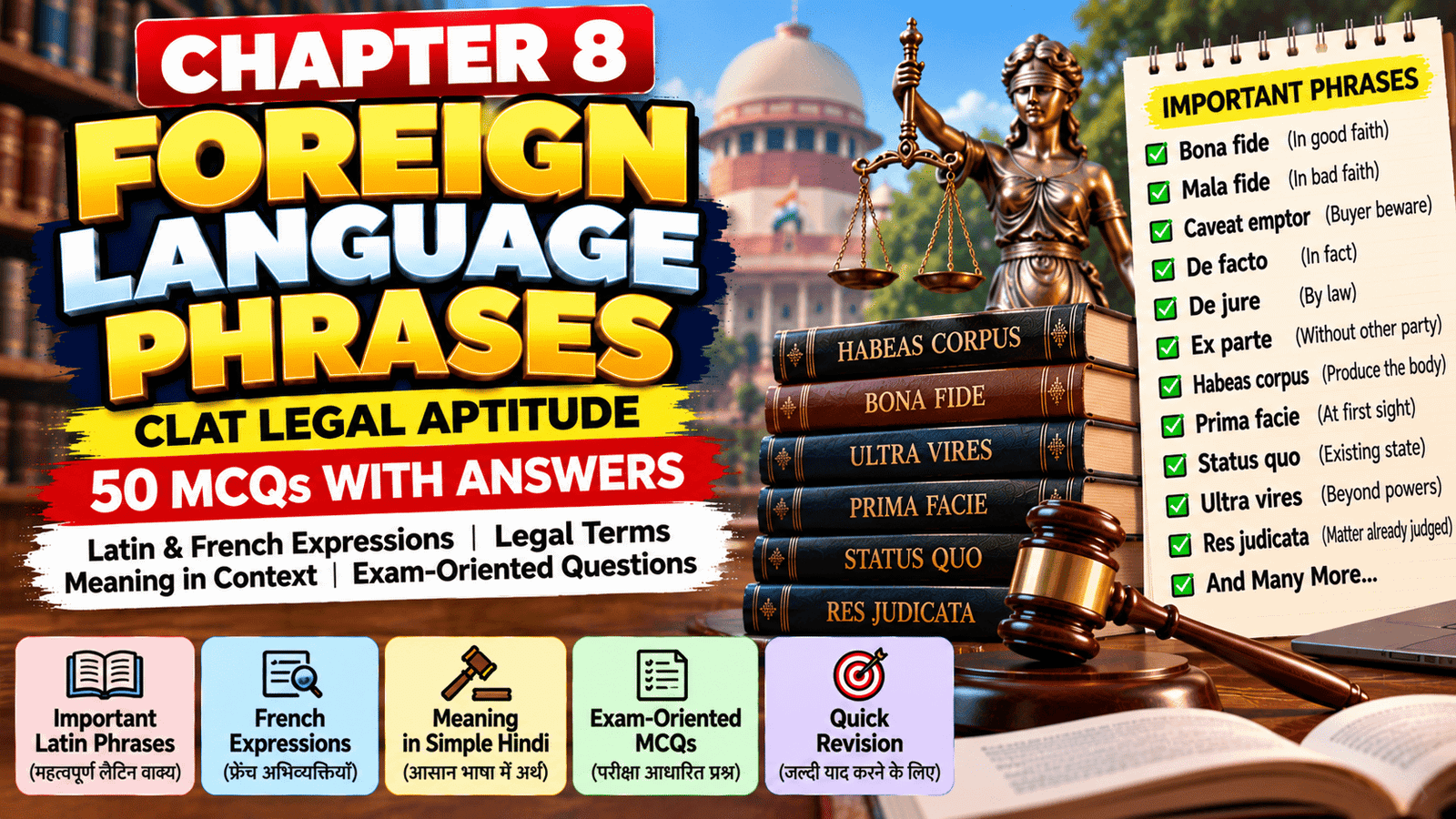
CLAT Foreign Language Phrases Questions 50 MCQs with Answers
CLAT 2027 Legal Aptitude Crash Course – Chapter 8
CLAT Aspirants | B.Tech Students | Non-Law Background Students
CLAT Legal Reasoning और Legal Aptitude की तैयारी में केवल legal concepts समझना ही पर्याप्त नहीं है। कई questions में ऐसे Latin और French phrases दिए जा सकते हैं जिनका meaning समझना जरूरी होता है।
इस chapter में आपको 50 exam-oriented Foreign Language Phrases Questions दिए गए हैं। हर question के साथ answer, आसान Hindi explanation और exam tip दिया गया है, ताकि आप केवल phrase का translation याद न करें बल्कि उसे legal context में भी समझ सकें।
CLAT Strategy: Foreign-language phrase को केवल रटने के बजाय Phrase + Meaning + Context + Related/Opposite Phrase के साथ याद करें।
इस Chapter में क्या पढ़ेंगे?
- Important Latin Legal Phrases
- Important French Expressions
- Legal Terminology
- Commonly Confused Pairs
- CLAT Vocabulary Traps
- Meaning in Context
- 50 Practice MCQs
- Quick Revision Table
- Memory Pairs
- 30-Second Revision Formula
PART 1 — CLAT FOREIGN LANGUAGE PHRASES: 50 MCQs
Q1. The Latin phrase “bona fide” means:
A. In bad faith
B. In good faith
C. By force
D. By law
ANSWER: B. In good faith
Explanation:
Bona fide का अर्थ है in good faith, यानी ईमानदारी से या genuine तरीके से।
Example:
The buyer was acting bona fide.
Exam Tip:
Bona = Good → Bona fide = Good faith
Q2. “Mala fide” means:
A. In good faith
B. In private
C. In bad faith
D. By itself
ANSWER: C. In bad faith
Explanation:
Mala fide का अर्थ है in bad faith, यानी गलत या बेईमान intention से।
याद रखें:
Bona fide = Good faith
Mala fide = Bad faith
Q3. The phrase “caveat emptor” means:
A. Seller beware
B. Buyer beware
C. Court beware
D. Law beware
ANSWER: B. Buyer beware
Explanation:
Caveat emptor एक Latin legal phrase है जिसका अर्थ है “let the buyer beware”।
इसका basic idea है कि buyer को purchase करते समय सावधान रहना चाहिए।
Caveat = Beware / Warning
Emptor = Buyer
Q4. “Caveat venditor” means:
A. Buyer beware
B. Seller beware
C. Buyer agrees
D. Seller agrees
ANSWER: B. Seller beware
Explanation:
Caveat venditor = Seller beware
यह caveat emptor का opposite concept है।
Emptor → Buyer
Venditor → Seller
Q5. A rule existing “de facto” exists:
A. By law
B. In fact
C. Temporarily
D. By agreement
ANSWER: B. In fact
Explanation:
De facto = In fact / In reality
जब कोई स्थिति practically मौजूद हो, तो उसे de facto कहा जा सकता है, भले ही वह formally legally established न हो।
Memory Pair:
De facto = In fact
De jure = By law
Q6. “De jure” means:
A. In fact
B. By law
C. By mistake
D. In private
ANSWER: B. By law
Explanation:
De jure = By law / Legally
Memory Trick:
De facto → Fact
De jure → Law
Q7. If a case is heard “ex parte”, it generally means:
A. Both parties are present
B. Without participation of the other party
C. Before a jury
D. After final judgment
ANSWER: B. Without participation of the other party
Explanation:
Ex parte ऐसी proceeding/action को refer करता है जिसमें दूसरी party की participation या presence नहीं होती।
Exam Tip:
Ex parte = One-sided proceeding
Q8. “Ex post facto” refers to something:
A. Before an event
B. After the fact
C. Without evidence
D. Under the law
ANSWER: B. After the fact
Explanation:
Ex post facto = After the fact
यह phrase विशेष रूप से किसी घटना के बाद किए गए law/action के context में दिखाई दे सकता है।
Q9. The writ “habeas corpus” is associated with:
A. Production of a detained person before the court
B. Appointment of a judge
C. Transfer of property
D. Payment of compensation
ANSWER: A. Production of a detained person before the court
Explanation:
Habeas corpus का literal sense है “produce the body.”
Legal context में इसका संबंध detained person को court के सामने लाकर detention की legality की जांच से है।
CLAT Tip:
Habeas Corpus → Detention → Court
Q10. “Ipso facto” means:
A. By that very fact
B. By another person
C. In private
D. After judgment
ANSWER: A. By that very fact
Explanation:
Ipso facto = By that fact itself / By the very fact
यह बताता है कि कोई result किसी particular fact के कारण directly follow कर सकता है।
Q11. “Locus standi” refers to:
A. Place of trial
B. Legal standing or right to appear before a court
C. Final judgment
D. Evidence in a case
ANSWER: B. Legal standing or right to appear before a court
Explanation:
Locus standi का अर्थ है court के सामने किसी व्यक्ति का legal standing/right to bring or participate in a case।
Memory:
Locus = Place
Standi = Standing
Q12. A court may find a claim “prima facie” valid when it appears valid:
A. After complete trial
B. At first sight/on the face of it
C. Only after appeal
D. Without any evidence
ANSWER: B. At first sight/on the face of it
Explanation:
Prima facie = At first sight / On the face of it
इसका अर्थ यह नहीं है कि claim final trial के बाद proved हो गया है। इसका मतलब है कि available material को देखकर पहली नजर में claim valid दिखाई देता है।
CLAT Trap:
Prima facie ≠ Final proof
Q13. “Status quo” means:
A. Previous condition
B. Existing state of affairs
C. Future condition
D. Illegal condition
ANSWER: B. Existing state of affairs
Explanation:
Status quo = Existing state of affairs, यानी वर्तमान स्थिति।
Example:
The court ordered the parties to maintain the status quo.
Q14. “Status quo ante” means:
A. Present condition
B. Future condition
C. Previous state of affairs
D. Legal authority
ANSWER: C. Previous state of affairs
Explanation:
Status quo = Current/existing position
Status quo ante = Previous position
यह एक important CLAT memory pair है।
Q15. A matter that is “sub judice” is:
A. Already decided
B. Under judicial consideration
C. Outside court jurisdiction
D. Privately settled
ANSWER: B. Under judicial consideration
Explanation:
Sub judice का अर्थ है कि कोई matter अभी court के consideration में है।
Exam Tip:
Sub judice = Matter pending before the court
Q16. If an authority acts ultra vires, it acts:
A. Within its legal powers
B. Beyond its legal powers
C. With public consent
D. Under emergency powers
ANSWER: B. Beyond its legal powers
Explanation:
Ultra vires = Beyond the powers
Ultra = Beyond
Vires = Powers
Opposite:
Intra vires = Within legal powers
Q17. “Intra vires” means:
A. Beyond powers
B. Within powers
C. Without authority
D. Against evidence
ANSWER: B. Within powers
Explanation:
Intra vires = Within the legal powers/authority
Memory Pair:
Ultra vires ↔ Intra vires
Q18. When a court takes action “suo motu”, it acts:
A. On its own motion
B. At the request of another court
C. After an appeal
D. Without jurisdiction
ANSWER: A. On its own motion
Explanation:
Suo motu = On its own motion
अर्थात court/authority किसी external application के बिना स्वयं action initiate करती है।
Q19. An “amicus curiae” is:
A. A court officer
B. A friend of the court who assists it
C. The accused person
D. A witness
ANSWER: B. A friend of the court who assists it
Explanation:
Amicus curiae का literal meaning है friend of the court।
ऐसा व्यक्ति या organization court को relevant legal information या perspective देने में सहायता कर सकता है।
Q20. “In camera” proceedings are conducted:
A. In public
B. In private
C. Online only
D. Outside the country
ANSWER: B. In private
Explanation:
In camera = In private / Confidentially
जब proceeding public setting के बजाय private/closed setting में conducted हो, तो उसे in camera proceeding कहा जा सकता है।
Q21. “Res judicata” means:
A. Matter to be decided
B. Matter already judged
C. Matter under investigation
D. Matter without evidence
ANSWER: B. Matter already judged
Explanation:
Res judicata का basic meaning है matter already adjudicated/judged।
Legal principle के रूप में यह broadly उसी matter को बार-बार litigate करने से रोकने से जुड़ा है।
Q22. “Res ipsa loquitur” means:
A. The law is supreme
B. The thing speaks for itself
C. The court must decide
D. The evidence is insufficient
ANSWER: B. The thing speaks for itself
Explanation:
Res ipsa loquitur = The thing speaks for itself
यह legal doctrine है जिसमें circumstances स्वयं negligence जैसी बात का strong indication दे सकते हैं।
Q23. “Mens rea” refers to:
A. Guilty act
B. Guilty mind
C. Legal remedy
D. Physical evidence
ANSWER: B. Guilty mind
Explanation:
Mens rea = Guilty mind / Criminal intention
Memory Pair:
Mens rea → Guilty mind
Actus reus → Guilty act
Q24. “Actus reus” means:
A. Guilty mind
B. Guilty act
C. Legal intention
D. Judicial reasoning
ANSWER: B. Guilty act
Explanation:
Actus reus = Guilty/wrongful act
Criminal law में इसे अक्सर mens rea के साथ pair में पढ़ा जाता है।
Q25. “Ratio decidendi” refers to:
A. A judge’s personal opinion
B. The legal reason/principle underlying a decision
C. Evidence produced by a witness
D. The final punishment
ANSWER: B. The legal reason/principle underlying a decision
Explanation:
Ratio decidendi वह legal principle/reason है जिस पर judicial decision आधारित होता है।
CLAT Tip:
Underlying legal principle = Ratio decidendi
Q26. “Obiter dicta” means:
A. Binding legal rule
B. Remarks made in passing
C. Final order
D. Written evidence
ANSWER: B. Remarks made in passing
Explanation:
Obiter dicta judge द्वारा judgment में की गई incidental या side observations को refer करता है।
याद रखें:
Ratio decidendi → Underlying legal principle
Obiter dicta → Incidental observations
Q27. “Quantum meruit” means:
A. As much as is deserved
B. Beyond legal power
C. Without evidence
D. By the court itself
ANSWER: A. As much as is deserved
Explanation:
Quantum meruit = As much as deserved
यह generally work done के लिए reasonable payment/compensation के context में इस्तेमाल हो सकता है।
Q28. “Per capita” means:
A. Per year
B. Per person
C. In proportion
D. By law
ANSWER: B. Per person
Explanation:
Per capita = Per person
Example:
Per capita income = income calculated per person.
Q29. “Per annum” means:
A. Per person
B. Per year
C. Per month
D. Per case
ANSWER: B. Per year
Explanation:
Per annum = Per year / Annually
Memory:
Annum = Year
Q30. “Pro rata” means:
A. In proportion
B. In private
C. By law
D. At first sight
ANSWER: A. In proportion
Explanation:
Pro rata = In proportion
जब किसी amount या benefit को proportion के अनुसार distribute किया जाए, तो उसे pro rata कहा जा सकता है।
Q31. “Vice versa” means:
A. In the same way
B. In reverse order or with the relation reversed
C. In private
D. Without evidence
ANSWER: B. In reverse order or with the relation reversed
Explanation:
Vice versa का अर्थ है कि relation का reverse भी true है।
Example:
A helps B, and vice versa.
अर्थात B भी A की मदद करता है।
Q32. “Per se” means:
A. By itself/in itself
B. By law
C. In public
D. In proportion
ANSWER: A. By itself/in itself
Explanation:
Per se = By itself / In itself / Intrinsically
Example:
The act is not illegal per se.
Q33. A committee formed “ad hoc” is created:
A. For a particular purpose
B. Permanently
C. By constitutional requirement only
D. After final judgment
ANSWER: A. For a particular purpose
Explanation:
Ad hoc = For a particular/specific purpose
यह अक्सर temporary या purpose-specific arrangement के लिए इस्तेमाल होता है।
Q34. “Ad interim” means:
A. Permanently
B. In the meantime/interim
C. After judgment
D. Without authority
ANSWER: B. In the meantime/interim
Explanation:
Ad interim = Temporary / Interim
जब final decision आने तक temporary arrangement हो, तब यह phrase इस्तेमाल हो सकता है।
Q35. “De novo” means:
A. Again or anew
B. By law
C. In proportion
D. In bad faith
ANSWER: A. Again or anew
Explanation:
De novo = Anew / Afresh
यदि कोई matter de novo consider किया जाता है, तो उसे नए सिरे से consider किया जाता है।
Q36. “Inter alia” means:
A. Among other things
B. Above the law
C. Without delay
D. Against the law
ANSWER: A. Among other things
Explanation:
Inter alia = Among other things
Formal और legal writing में यह phrase काफी common है।
Q37. “Mutatis mutandis” means:
A. Without any change
B. With necessary changes
C. By force
D. At first sight
ANSWER: B. With necessary changes
Explanation:
Mutatis mutandis = With the necessary changes having been made
Exam Tip:
इसे simple language में “with necessary modifications” के रूप में याद करें।
Q38. “Non sequitur” refers to:
A. A logical conclusion
B. An illogical conclusion
C. A legal remedy
D. A court order
ANSWER: B. An illogical conclusion
Explanation:
Non sequitur ऐसे conclusion को refer करता है जो previous statement से logically follow नहीं करता।
Example:
“He is rich, therefore he must be honest.”
यह conclusion necessarily logically follow नहीं करता।
Q39. “Modus operandi” means:
A. Method of operation
B. Legal standing
C. Previous condition
D. Judicial review
ANSWER: A. Method of operation
Explanation:
Modus operandi (M.O.) = Method or manner of operating
Crime-related contexts में किसी offender के usual method of committing an offence के लिए भी इसका उपयोग हो सकता है।
Q40. “In lieu of” means:
A. In addition to
B. Instead of
C. Because of
D. In front of
ANSWER: B. Instead of
Explanation:
In lieu of = Instead of / In place of
Example:
The employee received leave in lieu of overtime payment.
Q41. “Force majeure” refers to:
A. An ordinary business decision
B. An extraordinary event beyond reasonable control
C. A court judgment
D. A legal argument
ANSWER: B. An extraordinary event beyond reasonable control
Explanation:
Force majeure contractual/legal context में ऐसी extraordinary circumstances को refer करता है जो parties के reasonable control से बाहर हों और contractual performance को प्रभावित कर सकती हों।
Q42. “Faux pas” means:
A. A legal error
B. A social mistake or embarrassing error
C. A financial loss
D. A judicial order
ANSWER: B. A social mistake or embarrassing error
Explanation:
Faux pas French expression है जिसका अर्थ है social mistake या embarrassing breach of etiquette।
Q43. “Fait accompli” means:
A. An unfinished task
B. An accomplished fact
C. A legal warning
D. A false statement
ANSWER: B. An accomplished fact
Explanation:
Fait accompli ऐसी completed situation को refer करता है जिसे अब बदलना कठिन हो सकता है।
Memory:
Fait accompli → Already done
Q44. “Carte blanche” means:
A. Complete freedom or authority to act
B. Written warning
C. Legal punishment
D. Secret agreement
ANSWER: A. Complete freedom or authority to act
Explanation:
Carte blanche = Complete freedom/discretion to act
Example:
The manager was given carte blanche to reorganize the department.
Q45. “Vis-à-vis” means:
A. In relation to
B. Without evidence
C. After judgment
D. By force
ANSWER: A. In relation to
Explanation:
Vis-à-vis = In relation to / With regard to
Example:
India’s position vis-à-vis the new policy changed.
Q46. “Raison d’être” means:
A. Reason for existence
B. Reason for punishment
C. Method of operation
D. Existing legal position
ANSWER: A. Reason for existence
Explanation:
Raison d’être = Reason or purpose for existence
Memory:
Raison = Reason
d’être = Of being
Q47. If someone is “en route”, they are:
A. At home
B. On the way
C. Under arrest
D. In court
ANSWER: B. On the way
Explanation:
En route = On the way / While travelling toward a destination
Example:
We are en route to Delhi.
Q48. “Rendezvous” means:
A. A planned meeting
B. A legal punishment
C. A financial agreement
D. A warning
ANSWER: A. A planned meeting
Explanation:
Rendezvous = An arranged/planned meeting, especially at a particular place or time.
Q49. “Déjà vu” refers to:
A. A fear of the future
B. A feeling that one has experienced something before
C. A legal principle
D. A sudden decision
ANSWER: B. A feeling that one has experienced something before
Explanation:
Déjà vu French expression है। इसका अर्थ है ऐसा feeling कि current situation पहले भी experience की जा चुकी है।
Q50. A person declared “persona non grata” is:
A. A respected person
B. An unwelcome person
C. A legal expert
D. A court witness
ANSWER: B. An unwelcome person
Explanation:
Persona non grata = An unwelcome or unacceptable person
Diplomatic context में इसका विशेष उपयोग होता है।
Memory:
Persona = Person
Non grata = Not welcome
PART 2 — CLAT FOREIGN LANGUAGE PHRASES QUICK REVISION
| Phrase | Meaning |
|---|---|
| Bona fide | In good faith |
| Mala fide | In bad faith |
| Caveat emptor | Buyer beware |
| Caveat venditor | Seller beware |
| De facto | In fact |
| De jure | By law |
| Ex parte | Without the other party |
| Ex post facto | After the fact |
| Habeas corpus | Produce the body |
| Ipso facto | By that very fact |
| Locus standi | Legal standing |
| Prima facie | At first sight |
| Status quo | Existing state |
| Status quo ante | Previous state |
| Sub judice | Under judicial consideration |
| Ultra vires | Beyond powers |
| Intra vires | Within powers |
| Suo motu | On its own motion |
| Amicus curiae | Friend of the court |
| In camera | In private |
| Res judicata | Matter already judged |
| Res ipsa loquitur | Thing speaks for itself |
| Mens rea | Guilty mind |
| Actus reus | Guilty act |
| Ratio decidendi | Underlying legal principle |
| Obiter dicta | Remarks in passing |
| Quantum meruit | As much as deserved |
| Per capita | Per person |
| Per annum | Per year |
| Pro rata | In proportion |
| Vice versa | In reverse |
| Per se | By itself |
| Ad hoc | For a particular purpose |
| Ad interim | Interim |
| De novo | Anew |
| Inter alia | Among other things |
| Mutatis mutandis | With necessary changes |
| Non sequitur | Illogical conclusion |
| Modus operandi | Method of operation |
| In lieu of | Instead of |
| Force majeure | Extraordinary event beyond control |
| Faux pas | Social mistake |
| Fait accompli | Accomplished fact |
| Carte blanche | Complete freedom |
| Vis-à-vis | In relation to |
| Raison d’être | Reason for existence |
| En route | On the way |
| Rendezvous | Planned meeting |
| Déjà vu | Feeling of having experienced before |
| Persona non grata | Unwelcome person |
PART 3 — CLAT MOST IMPORTANT MEMORY PAIRS
1. Bona fide ↔ Mala fide
Good faith ↔ Bad faith
2. De facto ↔ De jure
In fact ↔ By law
3. Ultra vires ↔ Intra vires
Beyond powers ↔ Within powers
4. Status quo ↔ Status quo ante
Present state ↔ Previous state
5. Mens rea ↔ Actus reus
Guilty mind ↔ Guilty act
6. Ratio decidendi ↔ Obiter dicta
Underlying legal principle ↔ Incidental remarks
7. Caveat emptor ↔ Caveat venditor
Buyer beware ↔ Seller beware
PART 4 — CLAT FOREIGN LANGUAGE PHRASES: COMMON TRAPS
Trap 1: Prima Facie
Prima facie का मतलब final proof नहीं है।
यह केवल first sight / on the face of it की idea देता है।
Trap 2: De Facto vs De Jure
De facto = In fact
De jure = By law
इन दोनों को कभी reverse न करें।
Trap 3: Ratio Decidendi vs Obiter Dicta
Ratio decidendi = Decision का underlying legal principle
Obiter dicta = Incidental observations
Trap 4: Mens Rea vs Actus Reus
Mens rea = Mental element
Actus reus = Physical/wrongful act
Trap 5: Status Quo vs Status Quo Ante
Status quo = Existing/current state
Status quo ante = Previous state
PART 5 — FOREIGN LANGUAGE PHRASES को कैसे याद करें?
सिर्फ translation याद करना सबसे effective तरीका नहीं है।
इस formula को follow करें:
PHRASE → MEANING → CONTEXT → MEMORY PAIR
उदाहरण:
Ultra vires
↓
Beyond powers
↓
Authority ने अपनी legal power से बाहर action लिया
↓
Ultra vires ↔ Intra vires
इस तरह phrase को context के साथ याद करने से exam में पहचानना आसान हो सकता है।
PART 6 — CLAT QUESTION SOLVING STRATEGY
जब question में कोई foreign-language phrase दिया जाए, तो ये 5 steps follow करें:
STEP 1 — Phrase पहचानें
पहले देखें कि phrase Latin है या French।
STEP 2 — Basic meaning याद करें
जैसे:
Bona fide → Good faith
STEP 3 — Context पढ़ें
Phrase sentence में किस अर्थ में इस्तेमाल हुआ है?
STEP 4 — Similar options eliminate करें
अगर options में opposite meanings दिए हैं, तो memory pair का उपयोग करें।
STEP 5 — Final answer चुनें
Translation के साथ context भी verify करें।
PART 7 — 30-SECOND REVISION FORMULA
Exam से पहले इन pairs को जरूर revise करें:
Bona fide = Good faith
Mala fide = Bad faith
De facto = In fact
De jure = By law
Ultra vires = Beyond powers
Intra vires = Within powers
Mens rea = Guilty mind
Actus reus = Guilty act
Prima facie = At first sight
Status quo = Existing state
Status quo ante = Previous state
Sub judice = Under judicial consideration
Suo motu = On its own motion
Amicus curiae = Friend of the court
Ratio decidendi = Underlying legal principle
Obiter dicta = Remarks in passing
Quantum meruit = As much as deserved
Pro rata = In proportion
De novo = Anew
Inter alia = Among other things
Mutatis mutandis = With necessary changes
In lieu of = Instead of
Modus operandi = Method of operation
Force majeure = Extraordinary event beyond reasonable control
Persona non grata = Unwelcome person
Final Takeaway
CLAT में Foreign Language Phrases को केवल vocabulary की तरह नहीं पढ़ना चाहिए। इन phrases को meaning + context + legal usage + confusing pairs के साथ revise करना ज्यादा useful है।
सबसे important formula:
PHRASE पहचानो → MEANING समझो → CONTEXT पढ़ो → RELATED PAIR याद करो → OPTION ELIMINATE करो
अगर आपको bona fide, mala fide, de facto, de jure, ultra vires, intra vires, mens rea, actus reus, ratio decidendi और obiter dicta जैसे high-yield phrases अच्छी तरह याद हैं, तो Foreign Language Phrases वाले questions को तेजी से solve करना आसान हो सकता है।
Chapter 8 Complete — Foreign Language Phrases
CLAT Legal Aptitude Crash Course | 50 Exam-Oriented Questions | Easy Hindi Explanation
Study Smart: Phrase को अकेले मत रटिए। Phrase + Meaning + Example + Memory Pair के साथ revise कीजिए।