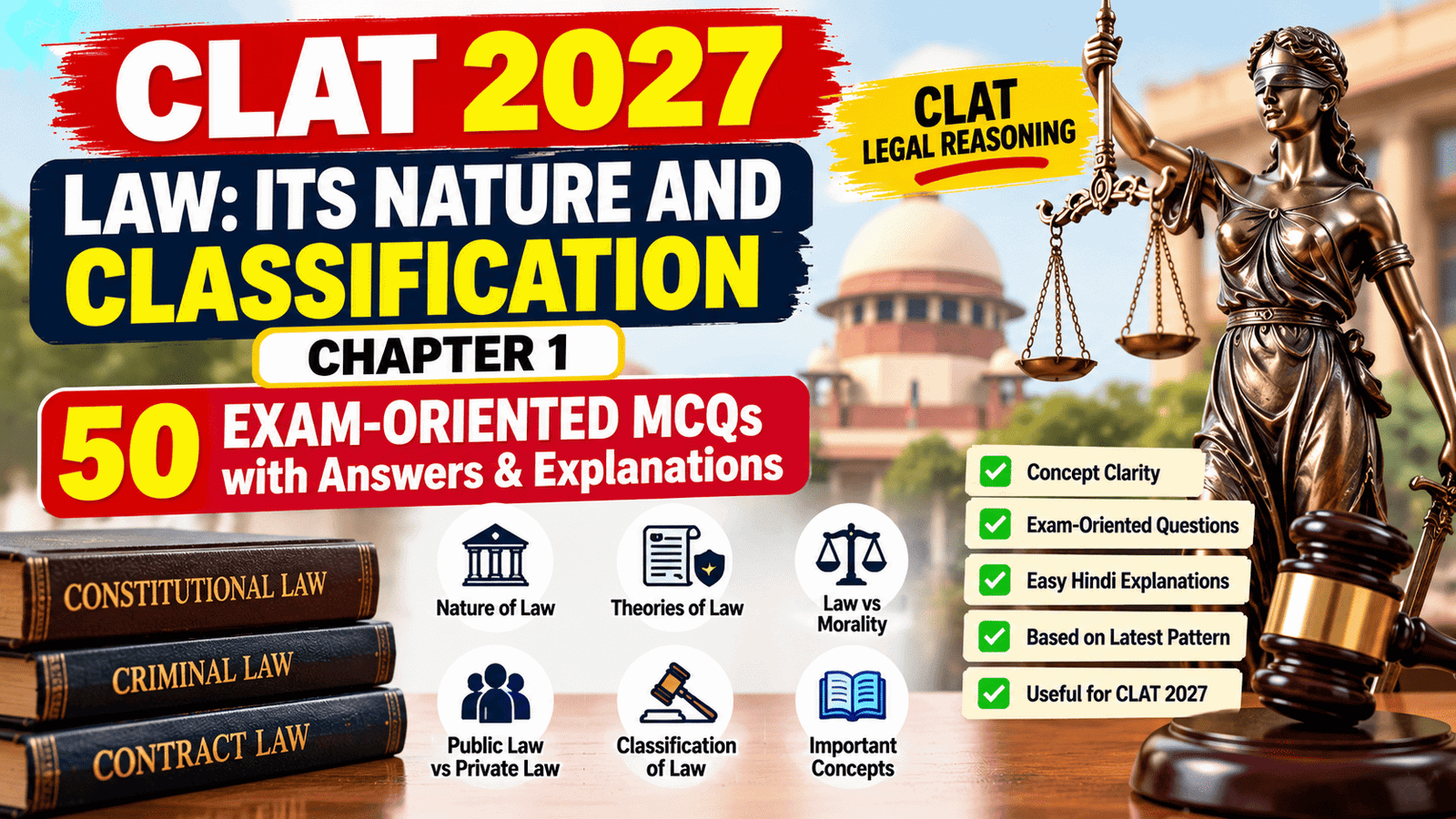
CHAPTER 1 — PRACTICE QUESTION BANK
LAW: ITS NATURE AND CLASSIFICATION
CLAT LEGAL REASONING
50 EXAM-ORIENTED MCQs WITH ANSWERS & EXPLANATIONS
QUESTION 1
Which of the following best describes the nature of law?
A. A set of personal opinions followed by individuals
B. A system of rules recognised and enforced by a legal authority
C. A collection of moral beliefs accepted by society
D. A set of religious practices followed voluntarily
Correct Answer: B. A system of rules recognised and enforced by a legal authority
Explanation:
Law केवल सलाह या personal opinion नहीं है। यह ऐसे rules का system है जिन्हें legal authority मान्यता देती है और आवश्यकता पड़ने पर enforce भी कर सकती है। इसलिए option B सबसे सही है।
QUESTION 2
According to John Austin, law is primarily understood as:
A. A command of the sovereign backed by sanctions
B. A moral principle accepted by society
C. A custom followed for generations
D. A decision given by any private individual
Correct Answer: A. A command of the sovereign backed by sanctions
Explanation:
Austin की Command Theory के अनुसार law sovereign का command है, जिसे obedience की अपेक्षा होती है और उसके पीछे sanction या punishment की शक्ति होती है। CLAT में Austin को पहचानने का मुख्य आधार command, sovereign और sanction है।
QUESTION 3
Which of the following is essential to Austin’s Command Theory?
A. Custom
B. Sovereign
C. Morality
D. Religion
Correct Answer: B. Sovereign
Explanation:
Austin के theory में sovereign central concept है। Sovereign वह supreme political authority है जिसकी commands को subjects generally obey करते हैं।
QUESTION 4
A government enacts a rule requiring citizens to pay a particular tax. A penalty is imposed on persons who deliberately refuse to comply. Which theory most directly explains this situation?
A. Natural Law Theory
B. Austin’s Command Theory
C. Historical School of Law
D. Sociological Theory
Correct Answer: B. Austin’s Command Theory
Explanation:
यहाँ authority ने command दिया है और उसके पालन के लिए penalty भी है। यही Austin की theory का मुख्य structure है — command backed by sanction।
QUESTION 5
Which statement correctly distinguishes law from morality?
A. Every moral rule is legally enforceable
B. Every legal rule is necessarily a moral rule
C. Law is generally enforced by legal institutions, whereas morality may operate through social or personal conscience
D. Law and morality are exactly the same
Correct Answer: C. Law is generally enforced by legal institutions, whereas morality may operate through social or personal conscience
Explanation:
Law और morality एक-दूसरे से related हो सकते हैं, लेकिन दोनों identical नहीं हैं। Legal rule के violation पर court या State action हो सकता है, जबकि moral rule के violation पर अक्सर social disapproval या personal guilt होता है।
QUESTION 6
A person behaves rudely towards an elderly person. The conduct may be considered immoral, but unless it violates a legal rule, it may not result in legal punishment. What does this illustrate?
A. Every immoral act is a crime
B. Every legal wrong is immoral
C. Difference between legal wrong and moral wrong
D. Difference between public and private law
Correct Answer: C. Difference between legal wrong and moral wrong
Explanation:
हर immoral act necessarily legal offence नहीं होता। Law उन acts पर legal consequences लगाता है जिन्हें legal system ने prohibited किया है। इसलिए legal wrong और moral wrong के बीच distinction समझना जरूरी है।
QUESTION 7
Which of the following is generally classified as public law?
A. Contract Law
B. Law of Torts
C. Constitutional Law
D. Property Law
Correct Answer: C. Constitutional Law
Explanation:
Public law मुख्यतः State और individuals या State institutions के बीच संबंधों तथा governmental powers को regulate करता है। Constitutional Law इसका प्रमुख example है।
QUESTION 8
Which of the following is generally classified as private law?
A. Constitutional Law
B. Administrative Law
C. Criminal Law
D. Contract Law
Correct Answer: D. Contract Law
Explanation:
Private law मुख्यतः private individuals या entities के बीच legal relationships को regulate करता है। Contract Law इसका classic example है।
QUESTION 9
A dispute arises between two private parties regarding the performance of a contractual obligation. Which branch of law would most directly govern the dispute?
A. Constitutional Law
B. Contract Law
C. Criminal Law
D. International Law
Correct Answer: B. Contract Law
Explanation:
दो private parties के बीच agreement से उत्पन्न rights और obligations को Contract Law regulate करता है। इसलिए यहाँ Contract Law सबसे directly applicable होगा।
QUESTION 10
Which statement best describes public law?
A. It regulates only family relationships
B. It primarily concerns the relationship between individuals and the State or the functioning of public authorities
C. It applies only to commercial transactions
D. It deals exclusively with contracts
Correct Answer: B. It primarily concerns the relationship between individuals and the State or the functioning of public authorities
Explanation:
Public law का focus State की powers, public institutions और State-individual relationship पर होता है। Constitutional और Administrative Law इसके प्रमुख examples हैं।
QUESTION 11
Which of the following best describes substantive law?
A. Law that primarily lays down procedures for enforcing rights
B. Law that defines rights, duties, liabilities and offences
C. Law dealing only with court fees
D. Law relating only to evidence
Correct Answer: B. Law that defines rights, duties, liabilities and offences
Explanation:
Substantive law यह बताता है कि किसी व्यक्ति के rights और duties क्या हैं और किस conduct से liability या offence पैदा होगा। यानी यह मुख्यतः legal rights और liabilities से जुड़ा होता है।
QUESTION 12
Which of the following best describes procedural law?
A. It defines moral standards
B. It determines the procedure through which legal rights and liabilities are enforced
C. It creates customs
D. It determines religious obligations
Correct Answer: B. It determines the procedure through which legal rights and liabilities are enforced
Explanation:
Procedural law court में case कैसे चलेगा, claim कैसे प्रस्तुत होगा और legal remedy कैसे प्राप्त होगी — इन प्रक्रियाओं से संबंधित होता है।
QUESTION 13
A law specifies that a person has a legal right to compensation when another person causes a legally recognised injury. This is primarily an example of:
A. Substantive law
B. Procedural law
C. Constitutional convention
D. Administrative procedure
Correct Answer: A. Substantive law
Explanation:
यहाँ law यह निर्धारित कर रहा है कि व्यक्ति का legal right क्या है और दूसरे व्यक्ति की liability क्या होगी। इसलिए यह substantive aspect है।
QUESTION 14
A separate rule prescribes the procedure for filing a claim before a court to obtain that compensation. This is primarily:
A. Substantive law
B. Procedural law
C. Criminal law
D. Customary law
Correct Answer: B. Procedural law
Explanation:
यह rule compensation का right create नहीं कर रहा, बल्कि उस right को enforce करने की procedure बता रहा है। इसलिए यह procedural law है।
QUESTION 15
Which of the following is the most appropriate distinction between substantive and procedural law?
A. Substantive law deals with rights and liabilities, while procedural law deals with their enforcement
B. Substantive law applies only to criminal cases
C. Procedural law creates all legal rights
D. There is no distinction between the two
Correct Answer: A. Substantive law deals with rights and liabilities, while procedural law deals with their enforcement
Explanation:
Exam में यह सबसे important distinction है: Substantive Law = rights, duties और liabilities; Procedural Law = उन rights और liabilities को enforce करने की process।
QUESTION 16
Which of the following is generally regarded as a characteristic of criminal law?
A. It primarily deals with offences against the State or society
B. It deals only with private contracts
C. It applies only to international disputes
D. It governs only property transfers
Correct Answer: A. It primarily deals with offences against the State or society
Explanation:
Criminal law में offences को केवल individual dispute नहीं माना जाता बल्कि society या State के interest के विरुद्ध wrong माना जाता है। इसलिए prosecution generally State द्वारा किया जाता है।
QUESTION 17
A person intentionally causes serious physical injury to another person in circumstances constituting an offence. The matter is prosecuted by the State. This is primarily a matter of:
A. Contract Law
B. Criminal Law
C. Property Law
D. Private International Law
Correct Answer: B. Criminal Law
Explanation:
जब conduct criminal offence की legal requirements को पूरा करता है, तो State prosecution कर सकती है। इसलिए यह criminal law का मामला है।
QUESTION 18
Which of the following is generally associated with civil law?
A. Punishment for an offence against society
B. Enforcement of private rights and remedies
C. Imprisonment as the primary objective
D. Prosecution by the State in every case
Correct Answer: B. Enforcement of private rights and remedies
Explanation:
Civil law generally private rights और disputes से संबंधित होता है। इसमें compensation, injunction या अन्य civil remedies मिल सकती हैं।
QUESTION 19
A agrees to sell a car to B, but later refuses to deliver the car despite having a valid contractual obligation. The dispute would primarily fall under:
A. Criminal Law
B. Contract Law
C. Constitutional Law
D. International Law
Correct Answer: B. Contract Law
Explanation:
यह dispute agreement के performance से संबंधित है। इसलिए इसका primary legal framework Contract Law होगा।
QUESTION 20
Which statement is most accurate regarding civil and criminal law?
A. Every civil wrong is a crime
B. Every crime is merely a private dispute
C. Civil law generally concerns private rights, while criminal law concerns offences recognised against society or the State
D. Civil and criminal law are identical
Correct Answer: C. Civil law generally concerns private rights, while criminal law concerns offences recognised against society or the State
Explanation:
Civil और criminal law का purpose और nature अलग होता है। Civil cases में private rights और remedies प्रमुख होते हैं, जबकि criminal law में offences और punishment का aspect प्रमुख होता है।
QUESTION 21
Which of the following is commonly recognised as a formal source of law?
A. Legislation
B. Personal preference
C. Rumour
D. Individual opinion
Correct Answer: A. Legislation
Explanation:
Legislation यानी competent legislative authority द्वारा बनाया गया law। यह modern legal systems में law का एक प्रमुख formal source है।
QUESTION 22
Which of the following is best described as legislation?
A. A rule created by a competent legislative authority
B. A personal moral belief
C. An informal conversation
D. A private promise without legal effect
Correct Answer: A. A rule created by a competent legislative authority
Explanation:
Legislation का मतलब है competent legislative body द्वारा formally enacted law। जैसे Parliament द्वारा बनाया गया statute।
QUESTION 23
Why is legislation considered an important source of law in a modern State?
A. It allows legal rules to be deliberately and systematically created
B. It depends entirely on personal morality
C. It is always based on ancient customs
D. It cannot be changed
Correct Answer: A. It allows legal rules to be deliberately and systematically created
Explanation:
Legislation का बड़ा advantage यह है कि legislature किसी social problem को identify करके deliberate तरीके से rule बना सकती है। इसलिए modern legal systems में इसका बहुत महत्व है।
QUESTION 24
A practice has been consistently followed by a community for a very long period and is accepted as legally obligatory. It may become a source of law as:
A. Custom
B. Legislation
C. Judicial review
D. Delegated legislation
Correct Answer: A. Custom
Explanation:
जब कोई practice लंबे समय से consistently follow हो और community उसे केवल habit नहीं बल्कि obligatory मानती हो, तो appropriate conditions में वह legal custom बन सकती है।
QUESTION 25
Which of the following is most important for a custom to acquire legal recognition?
A. It must merely be popular
B. It must satisfy the requirements recognised by law
C. It must be recent
D. It must be followed by one individual
Correct Answer: B. It must satisfy the requirements recognised by law
Explanation:
हर custom automatically law नहीं बन जाता। उसे legal requirements satisfy करनी होती हैं। केवल popular या frequently followed practice होना पर्याप्त नहीं है।
QUESTION 26
What is delegated legislation?
A. Law made directly by citizens without authority
B. Rules or regulations made by an authority under powers delegated by the legislature
C. Judicial decisions made by private persons
D. Moral rules created by society
Correct Answer: B. Rules or regulations made by an authority under powers delegated by the legislature
Explanation:
Legislature कभी-कभी किसी authority को detailed rules बनाने की power देती है। उस delegated authority द्वारा बनाए गए rules को delegated legislation कहा जाता है।
QUESTION 27
Why is delegated legislation used?
A. To eliminate the legislature completely
B. To enable detailed rules to be made under the framework of a parent statute
C. To replace the Constitution
D. To abolish judicial review
Correct Answer: B. To enable detailed rules to be made under the framework of a parent statute
Explanation:
Legislature हर technical detail खुद नहीं बना सकती। इसलिए parent Act के framework के अंदर rules या regulations बनाने की power delegate की जाती है।
QUESTION 28
Parliament passes a statute authorising a government department to make detailed regulations concerning implementation of the statute. The regulations made under this authority are an example of:
A. Constitutional law
B. Delegated legislation
C. Customary law
D. Natural law
Correct Answer: B. Delegated legislation
Explanation:
यहाँ Parliament ने parent statute बनाया और department को implementation के लिए detailed rules बनाने की authority दी। इसलिए यह delegated legislation है।
QUESTION 29
A delegated authority makes a rule that goes beyond the power granted to it by the parent statute. Such a rule may be described as:
A. Ultra vires
B. Ratio decidendi
C. Obiter dicta
D. Stare decisis
Correct Answer: A. Ultra vires
Explanation:
Ultra vires का अर्थ है “beyond the powers”. अगर delegated authority अपनी legally granted power से बाहर जाकर rule बनाती है, तो वह ultra vires हो सकता है।
QUESTION 30
Which principle limits the power of delegated legislation?
A. Delegated legislation must remain within the authority granted by the parent law
B. Delegated legislation can override the Constitution without limitation
C. Delegated legislation can create any rule whatsoever
D. Delegated legislation cannot be reviewed by courts
Correct Answer: A. Delegated legislation must remain within the authority granted by the parent law
Explanation:
Delegation का मतलब unlimited power देना नहीं है। Delegated authority को parent Act और Constitution की limits के अंदर रहना पड़ता है।
QUESTION 31
What is meant by judicial precedent?
A. A rule or principle derived from a previous judicial decision that may guide later cases
B. A rule created by a private individual
C. A religious instruction
D. A political speech
Correct Answer: A. A rule or principle derived from a previous judicial decision that may guide later cases
Explanation:
Judicial precedent में previous court decisions future cases के लिए guidance देते हैं। कुछ precedents court hierarchy के अनुसार binding भी हो सकते हैं।
QUESTION 32
The doctrine of stare decisis is primarily concerned with:
A. Following established judicial decisions
B. Creating legislation
C. Making contracts
D. Interpreting religious texts
Correct Answer: A. Following established judicial decisions
Explanation:
Stare decisis का basic idea है कि courts established judicial decisions और legal principles को follow करें ताकि consistency और certainty बनी रहे।
QUESTION 33
Which part of a judicial decision generally contains the legal principle necessary for deciding the case?
A. Ratio decidendi
B. Obiter dicta
C. Headnote only
D. Facts only
Correct Answer: A. Ratio decidendi
Explanation:
Ratio decidendi वह legal reasoning या principle है जो decision के लिए आवश्यक होता है। यही precedent के binding principle का मुख्य आधार बनता है।
QUESTION 34
Which of the following best describes obiter dicta?
A. The essential legal rule necessary for the decision
B. Observations made by a judge that are not essential to the decision
C. A statute enacted by Parliament
D. A constitutional amendment
Correct Answer: B. Observations made by a judge that are not essential to the decision
Explanation:
Obiter dicta का अर्थ है judge की ऐसी observations जो case decide करने के लिए strictly necessary नहीं थीं। वे generally persuasive value रख सकती हैं।
QUESTION 35
A court decides a case on the basis of a specific legal principle. The same court later considers another case involving materially similar facts. The earlier legal principle may operate as:
A. Judicial precedent
B. Custom only
C. Moral principle
D. Legislative delegation
Correct Answer: A. Judicial precedent
Explanation:
अगर previous decision का legal principle relevant और applicable है, तो वह subsequent case में precedent के रूप में काम कर सकता है। Binding effect court hierarchy पर depend करेगा।
QUESTION 36
Which statement correctly distinguishes ratio decidendi from obiter dicta?
A. Ratio is generally the necessary legal principle; obiter consists of observations not necessary for the decision
B. Ratio and obiter are always identical
C. Obiter is always a statute
D. Ratio refers only to facts
Correct Answer: A. Ratio is generally the necessary legal principle; obiter consists of observations not necessary for the decision
Explanation:
यह CLAT का बहुत important distinction है। Ratio = decision के लिए necessary legal principle, जबकि Obiter = additional observation।
QUESTION 37
A High Court interprets a statutory provision and lays down a legal principle necessary for deciding the case. A subordinate court within the same judicial hierarchy generally:
A. May ignore the principle whenever it disagrees
B. Must follow the binding principle, subject to the applicable hierarchy and legal exceptions
C. Must treat it only as a moral suggestion
D. Must convert it into legislation
Correct Answer: B. Must follow the binding principle, subject to the applicable hierarchy and legal exceptions
Explanation:
Judicial hierarchy में lower courts generally higher court के binding decisions को follow करते हैं। यही precedent system में consistency बनाए रखता है।
QUESTION 38
Which of the following best describes constitutional law?
A. Law dealing primarily with the structure, powers and functions of the State and fundamental legal principles
B. Law dealing only with private contracts
C. Law dealing exclusively with commercial transactions
D. Law relating only to customs
Correct Answer: A. Law dealing primarily with the structure, powers and functions of the State and fundamental legal principles
Explanation:
Constitutional Law State की structure, governmental powers, institutions और fundamental constitutional principles को govern करता है।
QUESTION 39
If an ordinary law conflicts with a superior constitutional requirement, which institution may generally be called upon to examine its constitutional validity?
A. Court
B. Private company
C. Individual citizen acting alone
D. Political party office
Correct Answer: A. Court
Explanation:
Courts constitutional validity examine कर सकते हैं। यदि कोई law Constitution के विरुद्ध पाया जाता है, तो appropriate judicial remedy उपलब्ध हो सकती है।
QUESTION 40
Judicial review primarily refers to the power of courts to:
A. Make every law themselves
B. Examine the legality or constitutional validity of governmental action and laws
C. Replace the legislature in all matters
D. Create political parties
Correct Answer: B. Examine the legality or constitutional validity of governmental action and laws
Explanation:
Judicial review का मतलब courts द्वारा legislative या executive action की legality या constitutional validity की जांच करना है। इसका उद्देश्य constitutional limits को maintain करना है।
QUESTION 41
Which of the following primarily governs relations between States at the international level?
A. International Law
B. Contract Law
C. Law of Torts
D. Family Law
Correct Answer: A. International Law
Explanation:
International Law देशों या States के बीच relations, international obligations और कई international matters को regulate करता है।
QUESTION 42
Which of the following may serve as a source or basis of international law?
A. International treaties
B. Personal opinions of tourists
C. Private advertisements
D. Informal rumours
Correct Answer: A. International treaties
Explanation:
International treaties States के बीच legally significant agreements होते हैं और international legal obligations का important source हो सकते हैं।
QUESTION 43
A treaty creates certain obligations between two States after they validly agree to be bound by it. This is an example of law arising through:
A. International agreement
B. Private morality
C. Domestic custom only
D. Judicial gossip
Correct Answer: A. International agreement
Explanation:
Treaty एक formal international agreement है। Validly binding treaty participating States के बीच international legal obligations create कर सकती है।
QUESTION 44
A legislature passes an Act authorising a regulatory authority to frame rules regarding licensing. The authority later creates a rule completely unrelated to licensing and imposes a new criminal offence without statutory authority. Which is the strongest legal objection?
A. The rule may be ultra vires the delegated power
B. The rule automatically becomes constitutional
C. The rule is necessarily a custom
D. The rule is automatically a judicial precedent
Correct Answer: A. The rule may be ultra vires the delegated power
Explanation:
Authority को केवल उतनी ही delegated power मिली है जितनी parent statute ने दी है। अगर authority उससे बाहर जाकर unrelated rule या unauthorised criminal offence बनाती है, तो rule ultra vires हो सकता है।
QUESTION 45
A community has followed a particular practice for many generations. However, the practice conflicts with a mandatory statutory provision. Can the practice automatically prevail as a legal custom?
A. Yes, because age always makes a custom superior to legislation
B. Yes, because every social practice is law
C. No, because a legally recognised custom cannot ordinarily override a contrary mandatory law
D. Yes, because customs are always superior to statutes
Correct Answer: C. No, because a legally recognised custom cannot ordinarily override a contrary mandatory law
Explanation:
Custom की legal recognition unlimited नहीं होती। अगर valid statutory provision के साथ direct conflict है, तो केवल पुराना होने के कारण custom statute के ऊपर नहीं आ जाता।
QUESTION 46
A judge states in a judgment: “In my opinion, modern technology will eventually require Parliament to reconsider this area of law.” The judge’s statement is not necessary to decide the dispute. It is most likely:
A. Ratio decidendi
B. Obiter dicta
C. Delegated legislation
D. Legislation
Correct Answer: B. Obiter dicta
Explanation:
यह statement case decide करने के लिए necessary नहीं है। Judge ने केवल additional observation दी है, इसलिए यह obiter dicta है।
QUESTION 47
A court decides that a particular statutory provision applies to a set of facts because of a specific legal principle. Which part of the judgment would normally carry the strongest precedential significance?
A. The judge’s unrelated personal remarks
B. The ratio decidendi
C. The newspaper report of the case
D. The parties’ private opinions
Correct Answer: B. The ratio decidendi
Explanation:
Precedent का core legal principle ratio decidendi होता है। वही principle future similar cases में binding या persuasive significance प्राप्त कर सकता है, depending on hierarchy।
QUESTION 48
Consider the following statements:
Statement I: Every custom followed by a large number of people automatically becomes law.
Statement II: A custom must satisfy the legal requirements for recognition before it can operate as a legal custom.
Which of the following is correct?
A. Both Statement I and Statement II are correct
B. Statement I is correct, but Statement II is incorrect
C. Statement I is incorrect, but Statement II is correct
D. Both Statement I and Statement II are incorrect
Correct Answer: C. Statement I is incorrect, but Statement II is correct
Explanation:
सिर्फ बहुत सारे लोगों द्वारा practice follow करने से वह automatically law नहीं बन जाती। Legal recognition के लिए आवश्यक conditions पूरी करनी होती हैं। इसलिए Statement I गलत और Statement II सही है।
QUESTION 49
Consider the following statements:
Statement I: Substantive law primarily determines legal rights and liabilities.
Statement II: Procedural law primarily provides the mechanism for enforcing legal rights and liabilities.
Which of the following is correct?
A. Both Statement I and Statement II are correct
B. Both Statement I and Statement II are incorrect
C. Statement I is correct, but Statement II is incorrect
D. Statement I is incorrect, but Statement II is correct
Correct Answer: A. Both Statement I and Statement II are correct
Explanation:
यह substantive और procedural law का fundamental distinction है। Substantive law rights और liabilities को define करता है, जबकि procedural law उन rights को enforce करने की process बताता है।
QUESTION 50
A legal system contains the following rules:
Rule 1: A statute creates a legal right and imposes a corresponding duty.
Rule 2: Another law prescribes the procedure for approaching a court when that right is violated.
Rule 3: A court’s earlier decision contains the legal principle used to interpret the statute.
Which classification correctly identifies Rules 1, 2 and 3?
A. Rule 1 — Procedural Law; Rule 2 — Substantive Law; Rule 3 — Custom
B. Rule 1 — Substantive Law; Rule 2 — Procedural Law; Rule 3 — Judicial Precedent
C. Rule 1 — Custom; Rule 2 — Criminal Law; Rule 3 — Legislation
D. Rule 1 — International Law; Rule 2 — Constitutional Law; Rule 3 — Morality
Correct Answer: B. Rule 1 — Substantive Law; Rule 2 — Procedural Law; Rule 3 — Judicial Precedent
Explanation:
Rule 1 rights और duties create कर रहा है, इसलिए यह substantive law है। Rule 2 उस right को court में enforce करने की procedure बताता है, इसलिए procedural law है। Rule 3 previous judicial decision से legal principle ले रहा है, इसलिए यह judicial precedent का example है。
CHAPTER 1 — TOPICS COVERED
1. Nature and Meaning of Law
2. Austin’s Command Theory
3. Sovereign and Sanction
4. Law and Morality
5. Legal Wrong and Moral Wrong
6. Public Law
7. Private Law
8. Substantive Law
9. Procedural Law
10. Civil Law
11. Criminal Law
12. Sources of Law
13. Legislation
14. Custom
15. Delegated Legislation
16. Ultra Vires
17. Judicial Precedent
18. Stare Decisis
19. Ratio Decidendi
20. Obiter Dicta
21. Constitutional Law
22. Judicial Review
23. International Law
24. Treaties as a Source of International Obligations
25. Application-Based Legal Reasoning
26. Statement-Based Questions
27. Principle-Based Questions
28. Conceptual Questions
29. Classification of Law
30. Relationship Between Different Sources of Law